






Perplexity vs ChatGPT: What Are The Differences in 2026?
Perplexity vs ChatGPT: Compare features, accuracy, pricing, and use cases to find out which AI tool fits your workflow best in 2026.
Frank is the founder of Readdy.ai. A developer-turned-founder with 10+ years of product experience, Frank loves great design, and he's building the tools he wishes he had when launching his first startup.
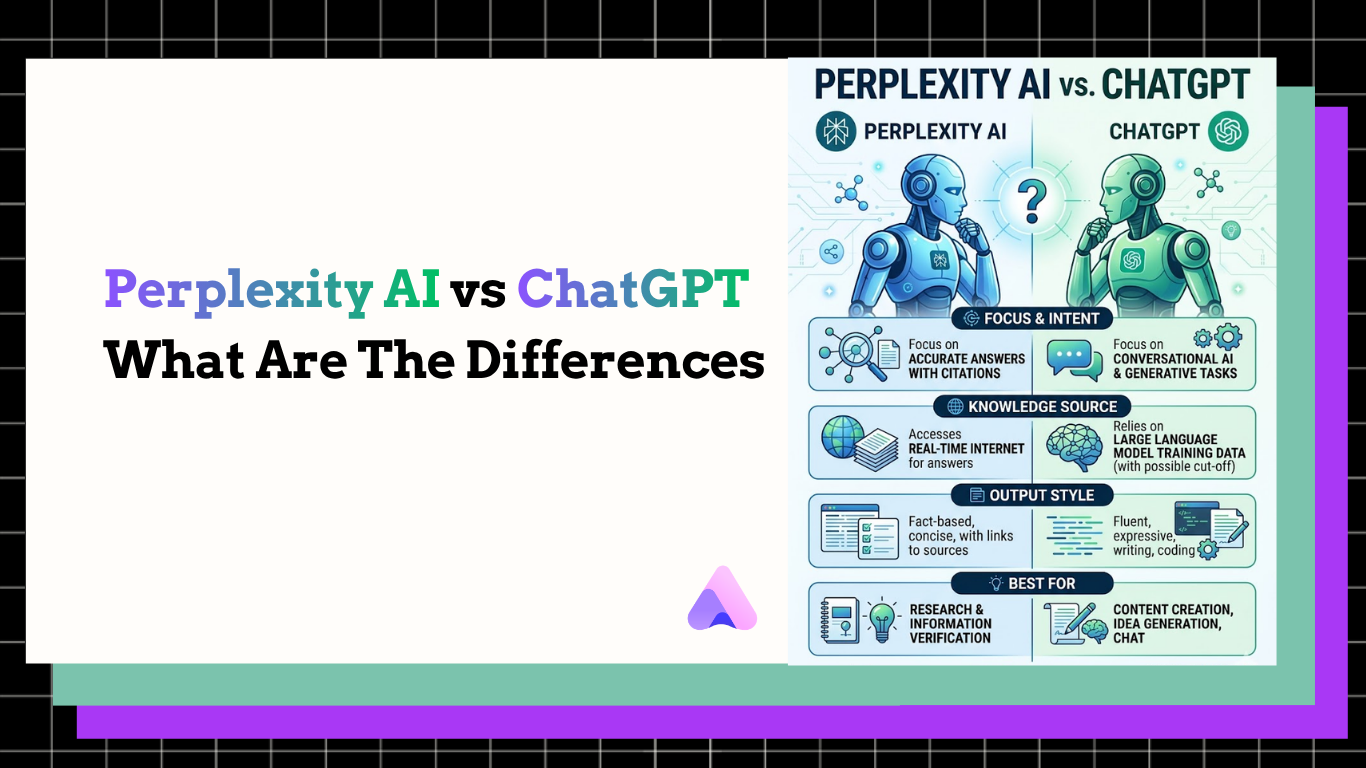
Perplexity AI is an AI search engine that answers users' questions accurately by retrieving and synthesizing live web data. It answers every query with numbered inline citations so you can verify where the information came from.
ChatGPT is an all-purpose conversational AI assistant that can perform tasks like researching, writing, coding, editing, analysing, and more. It is optimized for reasoning and generating creative content.

Quick Answer: Perplexity AI is an AI search engine that answers questions and provides cited sources pulled directly from the web. ChatGPT is a general-purpose AI assistant used for writing, coding, analysis, and complex reasoning. Perplexity AI is your best bet if you need fast, verifiable research with trackable sources. Go for ChatGPT if you need to write, build, analyze, or create.
Perplexity vs ChatGPT at a Glance
| Perplexity AI | Chat GPT | |
| Core purpose | AI-powered search engine | General-purpose AI assistant |
| Best for | Researchers, students, fact-checkers | Writers, developers, analysts, businesses |
| Key strength | Real-time citations from live web sources | Versatile generation: writing, code, reasoning |
| Pricing | $20/month (Pro) | $20/month (Plus) |
What Is Perplexity AI?: An AI-Powered Search Engine
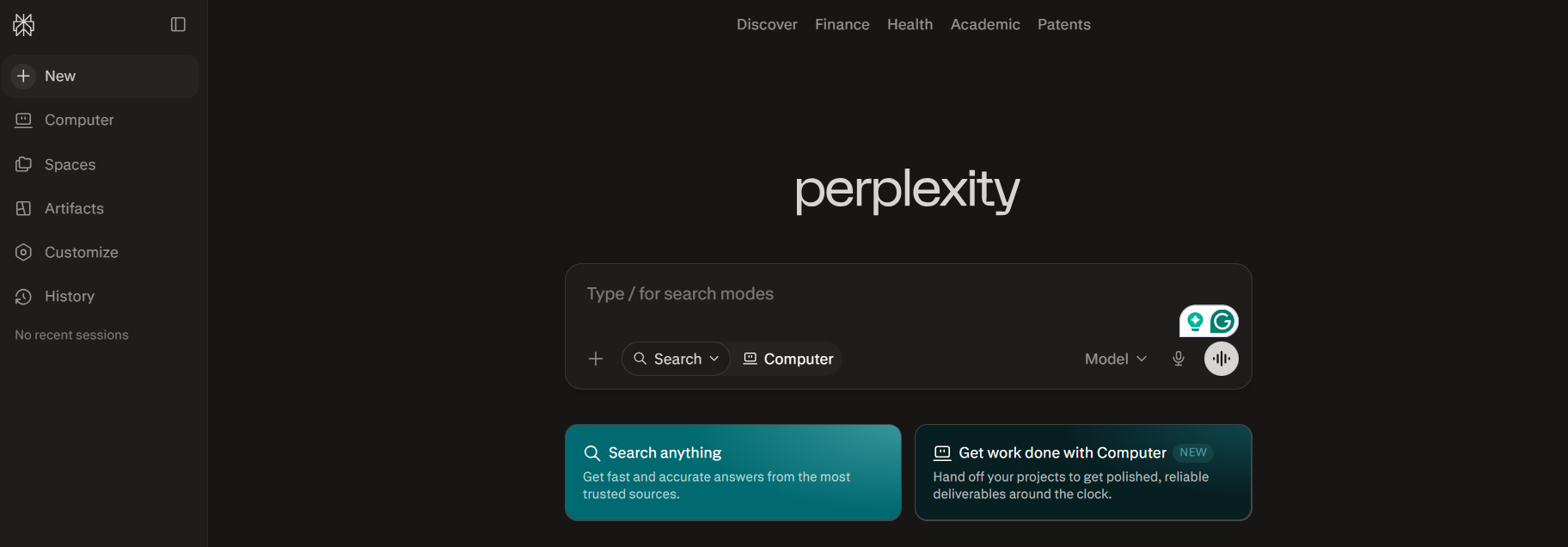
Perplexity AI is an AI-powered search engine that retrieves live web data with sources cited in real time. It was designed to replace the Google search experience with something faster and more direct.
When you ask Perplexity a question, it finds the sources with the most relevant content on the web, summarizes what they say, and then gives you numbered citations to every claim. This real-time web access reduces fabricated facts and hallucinations, compared to other chatbots that rely only on stored training data.
Users can access different search modes on Perplexity AI, depending on their project. The Academic Focus mode, for instance, only cites peer-reviewed databases like PubMed and Semantic Scholar, while the Standard mode, more flexibly, cites news outlets, community forums, and other live web pages.
Another unique feature is Perplexity Computer, available on the Perplexity Max subscription plan. It is an AI agent that functions as a co-worker and can execute complex workflows on its own. You describe your task in a prompt, and the agent breaks it down into several subtasks that it delegates to other AI models. It assigns each subtask to the model that’s best suited for it, so it might use Claude for reasoning, Gemini for deep research, and ChatGPT for website generation.
Perplexity AI is the only mainstream AI tool that retrieves information from the web in real time, offers inline citations in every response, and offers multiple search modes all at once, regardless of your subscription tier.
Who Perplexity is built for: Researchers, students, journalists, SEO professionals, analysts, and anyone who regularly fact-checks information or needs current data they can trace back to a source.
What Is ChatGPT?: An All-Purpose AI Assistant
ChatGPT is a general-purpose AI assistant built to handle writing, coding, data analysis, reasoning, and creative work across virtually any domain.
ChatGPT runs on GPT-5.5 for most paid users, and it provides access to a toolset that covers almost every type of knowledge work. ChatGPT is a superb partner for creative projects, data analysis, and coding, and users also get access to unique features like Canvas, custom GPTs, and ChatGPT Agent.
ChatGPT does have web search capabilities, but it decides on its own when to search the web and when to answer from training data, except when the user asks specifically. This makes it less reliable for current facts compared to Perplexity, but it gives a richer and more coherent output, since the model isn't constrained to summarizing whatever the top search results say.
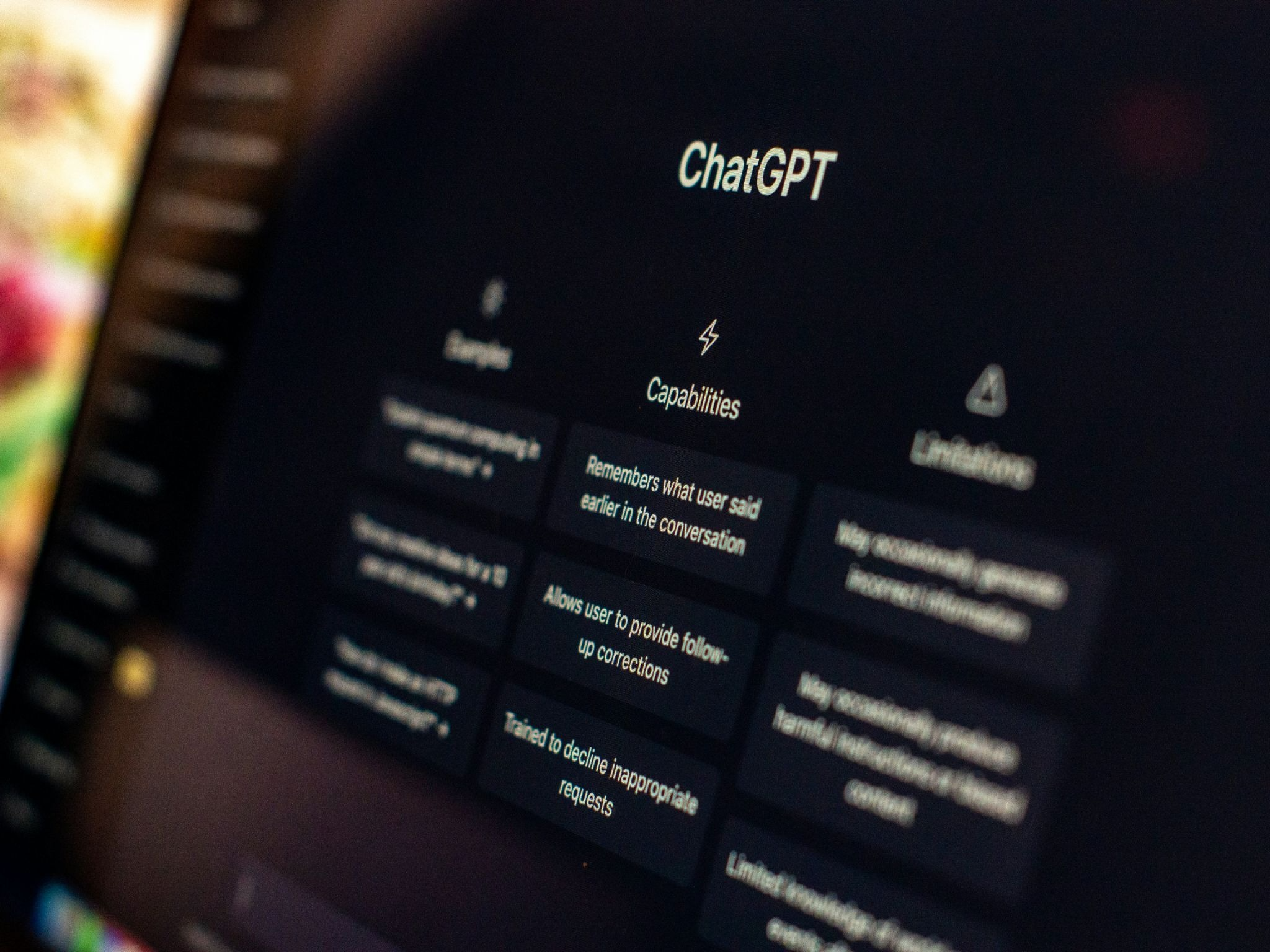
Other notable ChatGPT features in 2026 include:
- Canvas: A workspace for coding and writing that allows you to collaborate, edit, highlight sections for changes, and debug code in a side-by-side window.
- Image Creation: ChatGPT generates and edits images for business and personal use, including invitation cards, business cards, logos, and flyers.
- Video Generation: You can access built-in tools via the Explore GPTs section to create AI videos with scripts and voiceovers.
- Deep Research: The tool searches multiple sources and combines the search results into a cohesive report with proper citations and source links.
- Agent Mode: The AI gains access to a virtual computer environment, which allows it to perform tasks like browsing websites, filling forms, editing spreadsheets, and more.
- Advanced Voice Mode: This allows you to have natural and coherent conversations with the AI. It understands emotions, accents, and can be interrupted.
- Advanced Reasoning: This allows the AI to “think” before it answers to give more accurate answers.
ChatGPT is less of a chatbot and more of a full AI operating system, covering writing, coding, research, video, and autonomous task execution within a single subscription.
Who ChatGPT is built for: Writers, developers, marketers, content creators, business teams, students who need help with structured work, and anyone whose daily tasks involve generating or transforming text.
Perplexity vs ChatGPT Feature Comparison
Search and Web Access
The default for Perplexity AI is to search the web on every single query, while ChatGPT only uses its web search feature selectively.
Perplexity always retrieves fresh data before generating an answer, which means you're consistently getting information straight from live websites, forums, journals, and other online databases.
For ChatGPT, if your question sounds like it requires current information, it may search Bing's index. If it thinks it can answer from training data, it does that instead. This makes ChatGPT faster on many queries, but less reliable when you need up-to-date facts.
Perplexity usually provides more current and source-backed facts, while ChatGPT provides plausible and engaging answers that may be slightly outdated.
Citations and Sources
Perplexity shows citations for every response, numbered inline so you can click straight through to the source, while ChatGPT cites sources occasionally when using its browsing feature, but it's inconsistent.
On Perplexity, you can see exactly which websites the answer came from before you decide to trust the information. ChatGPT, on the other hand, will often give you a confident, well-written answer with no way to trace where the information came from.
The danger with Perplexity's citation approach is that citations lower your guard. A wrong answer with a source attached feels more authoritative than a wrong answer without one. It’s best to always open the source before using a Perplexity-cited fact in professional work.
Writing Quality
ChatGPT produces noticeably stronger long-form writing. It can maintain a consistent voice across thousands of words and follow guidelines about tone and structure. It can write fiction, satire, marketing copy, academic essays, or technical documentation without sounding like a summary.
Perplexity's writing output reads more like a compiled search result than an original piece. It has no persistent creative voice, no memory of your brand guidelines, and no ability to maintain narrative consistency over a long document. It is a research tool, not a writing tool.
Coding Assistance
ChatGPT is a stronger coding tool. It has Codex integrated directly into the Plus plan and above, so it can generate working code, explain what the code does, debug errors, write tests, and interact with your codebase through Agent Mode.
Perplexity can explain code and find documentation, but it has no code interpreter, and it can’t run or test code.
Reasoning and Problem Solving
ChatGPT's Advanced Reasoning mode can work through multi-step problems systematically and show its reasoning chain when needed. This makes it better for analytical tasks, mathematical problems, and complex decision frameworks.
Perplexity's reasoning is constrained by what the web currently says about a topic. If you ask it to reason through a novel problem or an open-ended scenario, it tends to surface existing opinions instead of an original analysis.
Image Generation
ChatGPT offers native image generation through GPT Images 2.0. It creates images from text prompts directly within the chat interface.
Perplexity AI offers image generation for Pro plan users and above through its integrations with third-party image models. But this is a secondary feature, not a core part of the product.
File Analysis
ChatGPT offers better file analysis than Perplexity AI. It can analyze PDFs, spreadsheets, images, and more with strong contextual understanding. It can summarize long reports, answer questions about uploaded files, and generate charts from data within the chat window.
Perplexity Pro also supports file uploads, but its analysis tends to be shallower. It's better suited for quickly extracting key facts from a document than for the kind of deep analytical work ChatGPT handles well.
Integrations and Ecosystem
Perplexity AI’s ecosystems and integrations are smaller compared to ChatGPT.
ChatGPT has one of the broadest AI ecosystems. Users can build custom GPTs for specific tasks without writing code. It can connect to third-party apps using plugins and integrations. The ChatGPT API is one of the most widely used in the industry, with a vast library of developer resources.
Perplexity offers an API through Sonar, which gives developers access to Perplexity's search infrastructure. It's useful for building applications that need real-time web retrieval with citations.
Accuracy, Hallucinations, and Trustworthiness
Perplexity is more reliable for current factual queries because it always retrieves real source material. We tried both platforms with the same test queries across technical, medical, legal, and historical topics. Perplexity AI had three minor inaccuracies with Perplexity, while ChatGPT had eleven.
ChatGPT can confidently invent historical events, fabricate scientific studies, or cite court cases that never happened. And because it sounds so confident, it's easy to believe. This hallucination does get better when browsing is enabled, but it’s still a strong possibility.
That said, Perplexity having fewer cases of hallucinations doesn’t make it trustworthy either. If the top-ranking web pages on a topic are biased, inaccurate, or outdated, Perplexity's summary will reflect those errors.
Users need to verify the information provided by both tools. The best workflow for high-stakes research is using Perplexity to locate and surface sources, then reading the actual sources before concluding.
Perplexity vs ChatGPT for Research
For research tasks that require current, verifiable, source-backed information, Perplexity AI is the more reliable tool. For synthesis, interpretation, and turning raw research into structured analysis, ChatGPT performs better.
Perplexity AI excels at the retrieval stage:
- finding what's been published,
- tracking down statistics,
- confirming that a claim has legitimate sourcing, and
- discovering perspectives from multiple outlets at once.
ChatGPT's Deep Research feature can autonomously generate research reports that pull from various sources and synthesize the information into a structured document. This is better for broad research briefs where you want an executive summary rather than a list of citations to read yourself.
For fact-checking and verifications, Perplexity is a better tool because every claim is linked.
Perplexity vs ChatGPT for Content Creation
For content creation, ChatGPT is the stronger tool across the board. Blog writing, copywriting, email sequences, social media content, and content ideation are all ChatGPT's strongest areas.
ChatGPT can write in a consistent voice, follow a detailed editorial brief, adjust tone based on the audience, and iterate quickly on drafts. The Canvas feature allows you to edit collaboratively, where you can highlight a section and ask the model to rewrite just that part. Content teams can improve productivity with these tools.
Perplexity, on the other hand, can draft short-form content and summaries, but it tends to write in an encyclopedic style. That’s fine for a research brief or a fact-dense summary, but a blog post needs personality and a narrative flow.
Both tools are useful for content ideation. Perplexity can surface what's currently being written about a topic across the web. ChatGPT can generate original angle ideas, frameworks, and structures from scratch.
You can combine both: use Perplexity to research the topic and identify what's already been said, then use ChatGPT to write original content that fills the gaps.
Perplexity vs ChatGPT for Coding and Development
ChatGPT is a better coding tool. Perplexity is useful for finding documentation and understanding APIs, but it cannot run, test, or execute code.
ChatGPT's Codex integration can generate complete functions, refactor existing code, write unit tests, explain what a block of code does line by line, and work through debugging in a conversational back-and-forth.
Perplexity's value in coding contexts is more like a faster Stack Overflow. If you need to understand a library, find an example implementation, or figure out what changed in a recent framework update, Perplexity's real-time search will often surface the answer with source links faster than a manual search would. But once you have that information, you need to bring it into a tool like ChatGPT, Cursor, or your IDE to actually do something with it.
Perplexity can also be useful for learning programming. It can retrieve and summarize learning materials when you need to understand a concept.
Which AI Tool Is Better for Different Users?
Students
Perplexity is a better tool for students. They can use it to find peer-reviewed sources and verify facts. Its free tier is also more functional for research than ChatGPT’s, which can be a plus for students on a budget.
Researchers
Perplexity Pro's Academic Focus mode is a genuinely differentiated feature for professional researchers. It gives access to peer-reviewed citations only, which saves time compared to manual searching. ChatGPT's Deep Research can also be useful, as it can build structured summaries once the source set has been identified.
Marketers
Marketers need both capabilities. Perplexity for competitive research, trend monitoring, and real-time industry news. ChatGPT for campaign copy, email sequences, landing page content, ad variants, and social posts.
SEO Professionals
Perplexity AI has become a more relevant platform for SEO professionals in 2026. As Perplexity grows in usage, getting cited in Perplexity answers is now a meaningful traffic and visibility opportunity. Perplexity has some of the highest conversion rates for SaaS products among AI platforms, which means citations there drive qualified visitors.
ChatGPT is useful for SEO content production, such as generating article outlines, writing meta descriptions, producing structured FAQ content, and improving existing pages.
Developers
ChatGPT with Codex is the primary tool. Perplexity fills a secondary research and documentation-lookup role.
Business Teams
ChatGPT's Business plan ($20 per user per month with annual billing) is a practical choice for business teams. It includes admin controls, shared workspaces, and team usage analytics. Perplexity's Enterprise Pro ($40 per seat per month) is better suited for teams whose primary use case is research, competitive intelligence, or information retrieval at scale.
Content Creators
ChatGPT is the best option for content creators. The writing quality, canvas editing feature, and ability to maintain creative consistency over long documents make it a more practical choice for anyone producing written content at volume.
Perplexity vs ChatGPT for GEO and AI Search Visibility
Getting cited in AI search results is a marketing and SEO objective for many businesses in 2026, and Perplexity and ChatGPT present two different citation opportunities.
Perplexity is cited in real time by retrieving from the live web. Any page that ranks well for a query has a chance of being cited. Perplexity is heavily citation-focused and has a strong preference for recent, up-to-date content. It is also more transparent about its sources than other platforms. For brands, this means keeping content current and publishing authoritative pages on target topics is the main lever for Perplexity visibility.
ChatGPT draws from Bing's index when it searches. To be cited by ChatGPT:
- Submit your sitemap to Bing Webmaster Tools,
- strengthen your site's E-E-A-T with named authors and visible dates,
- structure content as direct answers in short extractable paragraphs,
- implement schema.org structured data, and
- include verifiable statistics.
Research from Princeton University found that strategies like adding statistics and source citations can boost AI visibility by up to 40%.
Here are the best GEO practices for Perplexity and ChatGPT:
- Put your core answer in the first 80 words of any article
- Use comparison tables for any query involving multiple options
- Include specific, verifiable statistics with dates and sources
- Structure FAQ sections with clear question-and-answer pairs
- Write short, standalone paragraphs that can function as independent answer blocks
- Publish consistently so content stays current and gets re-indexed
Pricing Comparison and Value for Money
| Plan | Perplexity AI | ChatGPT |
| Free | Basic search, limited Pro queries | GPT-5 access, ~10 msg/5hrs, ads in US |
| Standard Paid | $20/month (Pro) | $20/month (Plus) |
| Mid-Tier | $200/month (Max) | $100/month (Pro Codex) |
| Premium | — | $200/month (Pro Max) |
| Team/Business | $40/seat/month (Enterprise Pro) | $20/user/month (Business) |
Perplexity Pro at $20/month includes unlimited Pro searches and access to GPT-4, Claude, and other models. The Max tier at $200/month adds multi-model orchestration through its Model Council feature, where multiple AI models can work on the same query simultaneously.
ChatGPT Plus at $20/month gives you access toss to GPT-5.5 Thinking, Deep Research at 10 runs per month, Agent mode, and a context window of approximately 320 pages.
At the $20/month tier, both tools are essentially price-matched. The difference is in what you get: Perplexity emphasizes cited research and model switching, ChatGPT leads in creative tasks.
How Perplexity + ChatGPT + Readdy AI Create a Complete Research-to-Website Workflow
Perplexity AI, ChatGPT, and Readdy can help you create a complete, fully deployable website with you writing a single line of code. Use Perplexity for research, ChatGPT to create the content of the website, and Readdy to generate a live website.
Perplexity AI Handles the Research Phase
Ask it about your topic, industry trends, competitor positioning, or audience questions. Every answer comes with sources. You can verify claims, identify credible statistics, and build a fact base you can actually trust before going forward. This is the stage where you get answers, source validation, and market or SEO research input that feeds directly into what you create next.
ChatGPT Handles the Creation Phase
Take the verified research from Perplexity and feed it into ChatGPT with a clear content brief. ChatGPT turns that research into polished drafts for blog posts, ad copy, email sequences, strategy documents, or sales pages. You can edit whatever it generates to improve clarity, adjust tone, and structure content in whatever format you require.
Readdy AI Website Builder Handles the Deployment Phase
Once content is created, Readdy turns it into a live, functional website without manual coding. It auto-generates website layouts from content, designs pages from text descriptions or screenshots, and deploys landing pages or SEO pages fast.

For marketers, founders, and content teams who need to move from research to a published page quickly, this three-tool workflow (Perplexity for research, ChatGPT for writing, and Readdy as the AI-powered website builder for deployment) covers the entire process end to end.
Pros and Cons of Each Platform
Perplexity Pros and Cons
Pros:
- Every answer includes inline citations with source links
- Always-on real-time web search, no toggle required
- Academic Focus mode for peer-reviewed source filtering
- Multi-model access on Pro and above (including GPT-5.5 and Claude Opus 4.8)
- Free tier is functional for basic research use cases
- Highly effective for GEO citation campaigns
Cons:
- Writing quality is noticeably weaker than ChatGPT for long-form content
- No code execution or interpreter
- Citations can sometimes come from low-quality or SEO spam sources
- Weaker creative output compared to conversational AI competitors
- Less suitable for non-research workflows like content production or task automation
ChatGPT Pros and Cons
Pros:
- Best-in-class writing quality across all formats and lengths
- Codex and Agent Mode for developer workflows
- Deep Research for multi-source autonomous report generation
- Canvas for real-time collaborative document editing
- Sora for AI video generation
- Custom GPTs for building task-specific tools
- Massive ecosystem and developer community
Cons:
- Web search is conditional, not always-on
- The hallucination rate is higher than the perplexity on factual queries
- Free tier is ad-supported in the US with tight usage limits
- More complex pricing structure with multiple tiers and feature gates
- Weaker citation transparency compared to Perplexity
Frequently Asked Questions
Is Perplexity more accurate than ChatGPT?
Yes. Perplexity AI is generally more accurate for current factual queries because it retrieves live web data and cites every source. ChatGPT answers more questions from its training data, which can be outdated. However, Perplexity is only as accurate as the sources it finds, and both tools require verification for high-stakes use.
Can Perplexity replace Google?
Yes, for search queries. Perplexity gives you a synthesized answer with citations rather than a list of links to click through. It's particularly effective for informational questions where you want a direct answer with sources. It's less effective for transactional searches like finding a local business or booking a flight.
Is ChatGPT better for writing?
Yes. ChatGPT consistently produces higher-quality writing than Perplexity, be it in blog posts, marketing copy, emails, essays, technical documentation, and creative content.
Which tool is better for students?
Perplexity is better. It can be used for finding and verifying research with traceable citations. ChatGPT can help students draft and structure arguments, but its research is not as reliable as Perplexity’s.
Which tool is better for SEO?
For GEO and AI search visibility, Perplexity matters more as a citation target because it actively cites web sources in every answer. For content production, keyword research, conversation, and writing optimized articles, ChatGPT is a more functional tool.
Is Perplexity worth paying for?
Yes, if research is a regular part of your work. The Academic Focus mode, unlimited Pro searches, multi-model access, and file uploads in the $20/month plan deliver real value for anyone who currently uses Google for research. For casual users, the free tier is sufficient.
Is ChatGPT worth paying for?
Yes, for most professional users. The free tier has message limits and ads, which can be frustrating. ChatGPT Plus at $20/month unlocks GPT-5.5, Deep Research, and Agent Mode. This toolkit can improve how much you can get done in a day.
Which AI tool offers better value?
Perplexity offers more for research-heavy workflows. ChatGPT offers more for creation and production workflows. If you only pick one and your work involves more building and writing than fact-finding, ChatGPT is the better value. If you spend most of your day researching and verifying information, Perplexity is better.
Which tool is best in 2026?
Perplexity AI is the best AI search tool in 2026. ChatGPT is the best general-purpose AI assistant in 2026. It's more about which fits your workflow. Most serious users end up with both, using Perplexity to find and verify information and ChatGPT to create something with it.
Final Verdict
Perplexity AI is the right tool for research with verifiable sources. With real-time web search and inline citation, it is the best option for research, fact-checking, competitive intelligence, and any workflow where you need to trace information back to a source. The $20/month Pro plan is one of the most practical research subscriptions available in 2026.
ChatGPT is the right tool when you need to build, write, or create something. It is a more versatile product for professionals who spend their days producing content, writing code, analyzing data, or running multi-step workflows. At $20/month for Plus, or $100/month for Pro Codex if you're a heavy developer, it delivers a wide feature set.
The most effective AI workflow in 2026 uses Perplexity AI for cited research and ChatGPT for content creation and reasoning. Neither tool should be used without verification. Both hallucinate, and both have limits. The people getting the most out of AI in 2026 let each tool do what it does best, and humans review the output before it goes anywhere important.

Frank Zhu
Frank is the founder of Readdy.ai. A developer-turned-founder with 10+ years of product experience, Frank loves great design, and he's building the tools he wishes he had when launching his first startup.