






Grok vs ChatGPT (2026): Which AI Is Better for You?
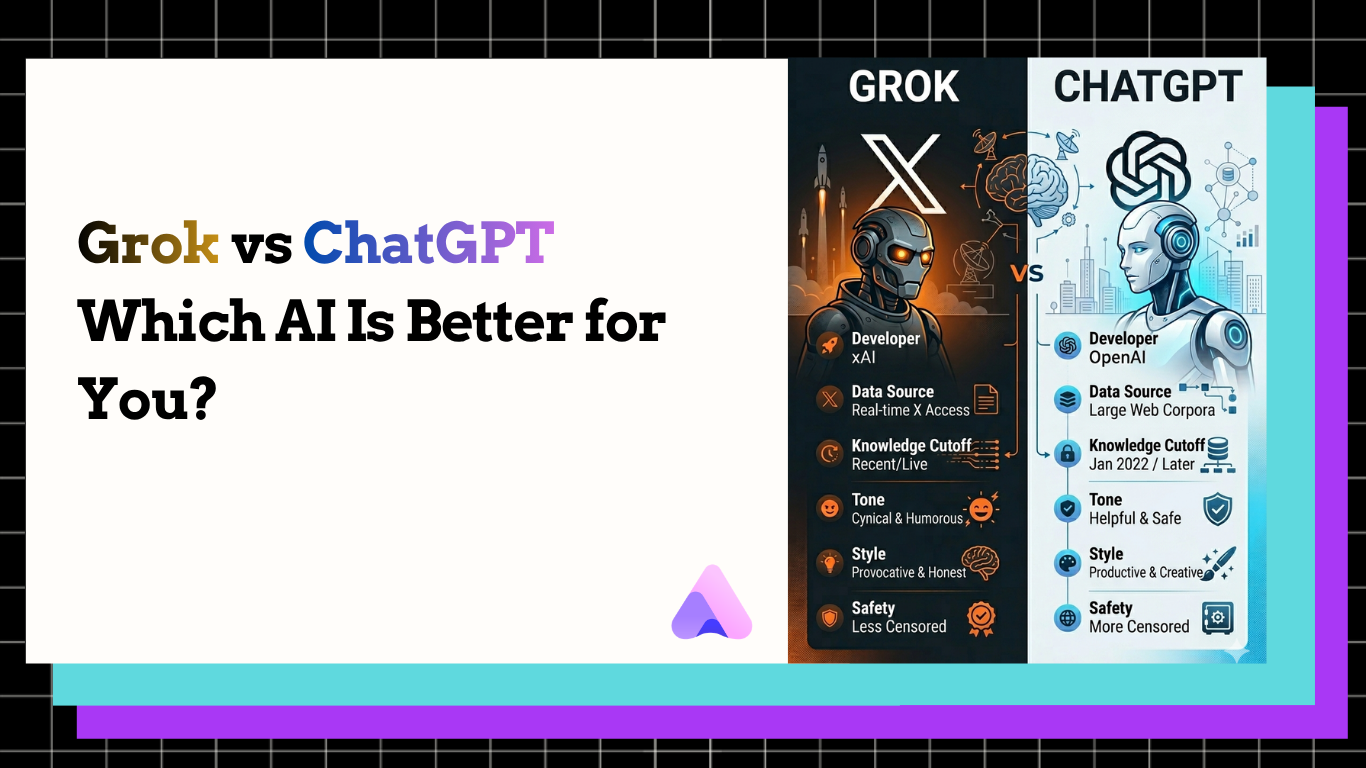
Grok vs ChatGPT compared for real-time data, writing, coding, and pricing in 2026. An honest breakdown of which AI fits your workflow, and when to use both.
Frank is the founder of Readdy.ai. A developer-turned-founder with 10+ years of product experience, Frank loves great design, and he's building the tools he wishes he had when launching his first startup.
Two of the most talked-about AI assistants in 2026 come from very different places. ChatGPT is OpenAI's flagship product: mature, widely integrated, used by over 180 million people weekly, and the model against which everything else tends to get measured. Grok is xAI's answer to that, built by Elon Musk's company with a deliberate anti-corporate personality, native access to X's live data stream, and a 2 million token context window that no other mainstream AI can match.
The grok vs chatgpt comparison 2026 is interesting because neither is straightforwardly better. Grok wins in specific, important ways, particularly anything requiring live, real-world information. ChatGPT wins in others: broader multimodal capability, a larger ecosystem, and a more consistent track record for professional writing and complex reasoning. The right answer depends entirely on what you're using AI for.
This guide covers the differences that matter: performance, real-time data, content creation, coding, and pricing, and includes a practical workflow for turning AI-generated output into a published website. Whether you're approaching the chatgpt vs grok question as a content creator, developer, or someone just deciding which tool to use day-to-day, the answer depends on your specific workflow.
TL;DR: Grok or ChatGPT?
For real-time data and current events: Grok. Its native X integration gives it live access to breaking news and trending discussions that ChatGPT can't match natively.
For professional writing and long-form content: ChatGPT. More consistent structure, better tone control, and a stronger track record for SEO and editorial work.
For coding and development: ChatGPT edges ahead: more idiomatic output, better debugging, and a larger developer ecosystem. Grok 4 is competitive but not the default choice.
For price: ChatGPT Plus at $20/month offers more features than SuperGrok at $30/month for most users. Grok only pulls ahead if you specifically need the live X data.
For a larger context window: Grok, by a significant margin. Its 2 million token context window vs ChatGPT's 128K is a real differentiator for working with large documents or codebases.
For turning AI-generated content into a website: Neither does. Use Readdy. Generate your copy and structure with ChatGPT or Grok, then build and publish the site in minutes using an AI website builder that does the design and layout work for you.
What Is Grok?
Grok is an AI assistant built by xAI, Elon Musk's artificial intelligence company, and launched in late 2023. The current flagship is Grok 4, which runs inside the X platform (formerly Twitter) and through the standalone xAI interface. SuperGrok subscribers get full Grok 4 access along with Grok 3, the Imagine image generation model, and a context window that can hold up to 2 million tokens.
What sets Grok apart from competing AI assistants is its direct, real-time connection to X's social data feed. Where other AI tools require you to explicitly enable web browsing or use a search tool, Grok sees the current state of X natively, which gives it a genuine edge for any query where what happened today matters more than what happened last year.
Grok's personality is deliberately different from ChatGPT's. It's more casual, more willing to engage with edgy topics, and less filtered by default. That's a feature for some users and a concern for others, particularly in professional or brand-sensitive contexts.
What Is ChatGPT?
ChatGPT is OpenAI's conversational AI, launched in November 2022 and now arguably the most widely used software product in history. The current version runs on GPT-5.1, released in late 2025, with GPT-4o still available across plans. ChatGPT supports text, images, audio, and limited video input, making it the more capable multimodal tool of the two.
The platform has evolved well beyond a chatbot. Canvas mode lets you edit long documents collaboratively. Custom GPTs allow users to build specialised versions for specific workflows. Advanced Data Analysis processes spreadsheets and datasets directly. Memory retains context across sessions. The ecosystem around ChatGPT, including thousands of API integrations and third-party tools, is substantially larger than anything currently built around Grok.
For professional and enterprise use, ChatGPT carries more compliance infrastructure, clearer data privacy frameworks, and a longer track record of consistent, structured output.
Grok vs ChatGPT: Key Differences
| Factor | Grok | ChatGPT |
| Developer | xAI (Elon Musk) | OpenAI |
| Current model | Grok 4 | GPT-5.1 |
| Real-time data | Native X integration (live) | Web browsing (enabled) |
| Context window | 2 million tokens | 128K tokens |
| Multimodal support | Text, image, limited voice | Text, image, audio, video |
| Coding ability | Competitive, improving | Stronger overall |
| Writing quality | Casual, witty | Structured, professional |
| Image generation | Imagine / Aurora | DALL-E 3 |
| Safety filtering | Less restrictive | More conservative |
| Free tier | Yes (limited) | Yes (GPT-4o with limits) |
| Paid tier (entry) | SuperGrok $30/month | ChatGPT Plus $20/month |
| Best for | Real-time data, X users | Writing, coding, general use |
Grok vs ChatGPT Performance: Which Is Smarter in 2026?
On raw benchmark performance, the grok vs chatgpt comparison is genuinely close. In LMSYS Chatbot Arena rankings, which measure real user preferences in blind comparisons, Grok 3 achieved an Elo rating of 1402, placing it among the top five models globally. GPT-4o scored approximately 1380, with GPT-5 variants scoring higher in specific domains like structured reasoning and instruction-following.
In practice, the performance difference between the two shows up most clearly in specific task types rather than across the board.
ChatGPT tends to perform better on structured, multi-step reasoning problems: things like layered business analysis, complex logical sequences, or research tasks requiring precise sourcing. Its lower hallucination rate in extended document analysis (approximately 12% fewer errors than Grok in enterprise evaluations) gives it the edge for accuracy-critical work.
Grok has a consistent advantage in open-ended exploration and conversational depth. Its multi-agent reasoning mode, which it calls "think" or "big brain" mode, approaches problems from multiple angles simultaneously and can surface perspectives that a more linear reasoning model would miss. The tradeoff is occasional verbosity: Grok sometimes adds editorial commentary or humour where a direct answer would serve better.
For everyday tasks: summarising a document, drafting an email, answering a factual question, the difference between the two is small enough that most users won't notice. The gap becomes visible at the edges: very large document analysis (where Grok's 2M context window is a genuine advantage), complex technical reasoning (where ChatGPT's consistency pays off), and live information retrieval (where Grok wins clearly).
Grok vs ChatGPT for Real-Time Data: Which AI Knows What's Happening Now?
This is the category where the chatgpt vs grok comparison has the clearest winner: Grok.
Grok's native integration with X gives it access to live posts, trending topics, and real-time discussion in a way that no other mainstream AI assistant can replicate natively. Ask Grok about a market-moving event from this morning, a product launch announced yesterday, or a political development from the last hour, and it typically produces an informed, current answer. Ask ChatGPT the same question without its web browsing tool explicitly enabled, and you're working with training data that has a knowledge cutoff.
ChatGPT has improved its web search capabilities considerably, and with browsing enabled on Plus plans it can retrieve current information. But there's a practical difference between a tool that natively surfaces what's happening on the world's largest real-time discussion platform and one that performs a targeted web search. For trend analysis, market sentiment, breaking news, and social media monitoring, Grok's live X data is a genuine product advantage that ChatGPT doesn't currently match.
For historical research, technical documentation, or anything where recency matters less than depth, ChatGPT's training on long-form text and scientific literature gives it the edge. Grok's real-time strength doesn't compensate for the breadth and structure of ChatGPT's training data in contexts where deep, well-sourced analysis is the goal.
The practical rule: if your question has "right now" in it, use Grok. If your question has "explain thoroughly" in it, use ChatGPT.
Grok vs ChatGPT for Content Creation: Writing, SEO, and Copywriting
For content professionals: writers, marketers, and SEO teams, this comparison is probably the most relevant.
ChatGPT is the stronger choice for most professional writing applications. The GPT-5.1 model produces structured, tonally consistent long-form content with good heading hierarchy, logical flow, and fewer digressions. For SEO content specifically, ChatGPT's ability to follow structured briefs, maintain keyword placement, and produce editorially coherent output over thousands of words makes it the dominant tool for content teams.
Grok's writing has a different character: more conversational, more opinionated, and occasionally more interesting in the way a good journalist's copy is interesting. For social media content, where voice and personality matter more than structure, Grok's natural irreverence is an asset. It tends to produce copy that sounds less like AI and more like a human who has strong opinions.
Blog articles and long-form SEO content: ChatGPT. Better structure, more consistent with editorial guidelines, and less likely to introduce digressions.
Social media copy and brand voice work: Grok, if the brand has a more casual or edgy voice. ChatGPT if the brand is professional.
Email marketing: Either, depending on tone. ChatGPT for formal or transactional; Grok for brands that want personality.
Technical writing and documentation: ChatGPT, clearly.
From AI Content to a Live Website: Where Readdy Fits
Both ChatGPT and Grok are excellent at generating content: copy, structure, headlines, product descriptions, about page text. What neither tool does is turn that content into a published website. That requires a different step, and this is where the workflow becomes interesting.
A practical content-to-website workflow looks like this:
Step 1: Use ChatGPT or Grok to generate your content
Ask your AI assistant to draft homepage copy, service descriptions, an about page, or blog content. Be specific about tone, audience, and structure. Both tools produce usable first drafts quickly.
Step 2: Bring it into Readdy
Readdy's AI website builder takes your content and context and generates a complete, multi-page website: layout, sections, imagery, and responsive design included. You can describe your business, paste in your AI-generated copy, or upload a reference screenshot. The AI structures it into a site that's ready to refine, not a blank template to fill.
Step 3: Refine and publish
Edit sections through the visual editor or give the AI natural language instructions. Connect your domain. Readdy handles hosting, SSL, and SEO configuration automatically.
The combination works because each tool does what it's genuinely good at. ChatGPT and Grok are excellent at producing raw content. Readdy's AI-powered website builder is built to turn content into a structured, published website fast. Rather than copying AI-generated text into a template builder one section at a time, you describe your business to Readdy's AI and get a complete starting point in under a minute.
For founders, freelancers, and small businesses who already use AI for content and want a website to match, this workflow reduces what used to be a days-long process to an afternoon.
Grok vs ChatGPT for Coding: Which AI Is Better for Developers?
ChatGPT maintains a general edge in coding, though the gap has narrowed with Grok 4. In independent testing across languages including Python, JavaScript, TypeScript, and SQL, ChatGPT produces more idiomatic code that follows community conventions, handles edge cases more reliably, and writes cleaner inline documentation.
For production-grade development work: debugging, refactoring, code review, API integration, ChatGPT's consistency is the deciding factor. Enterprise evaluations show lower error rates in extended code generation tasks, and the OpenAI developer ecosystem (including Codex-derived tools and deep integrations with IDEs and CI/CD workflows) gives it a structural advantage for teams.
Grok 4 is genuinely competitive in raw code generation, and for certain tasks, particularly Python scripts, mathematical algorithms, and anything where Grok's access to current documentation and Stack Overflow discussions is relevant, it performs comparably. One area where Grok's speed advantage (approximately 1,200 tokens per second versus GPT-5.2's slower output) matters practically is in generating large blocks of boilerplate code.
For most developers, ChatGPT remains the primary tool and Grok a useful secondary resource, particularly for tasks where current library versions and recent documentation matter.
Grok vs ChatGPT Pricing (2026): Which Offers Better Value?
| Plan | ChatGPT | Grok |
| Free | GPT-4o with limits | Grok 3 with limits |
| Entry paid | Plus: $20/month | SuperGrok: $30/month |
| What's included | GPT-4o, GPT-5.1 (limits), DALL-E 3, Canvas, web browsing, Custom GPTs | Grok 3 + Grok 4 access, 128K context, Imagine image generation |
| High tier | Pro: $200/month (o3 reasoning) | SuperGrok Heavy: $300/month (enterprise) |
For the majority of users, ChatGPT Plus at $20/month delivers more value than SuperGrok at $30/month. ChatGPT Plus includes Canvas, Custom GPTs, Advanced Data Analysis, DALL-E 3, and full GPT-4o access: a broader feature set for $10 less per month.
SuperGrok makes financial sense in two specific scenarios: you rely heavily on X/live data and need Grok's native real-time access, or you need the 2 million token context window for working with very large documents.
For developers, Grok 4.1 Fast at $0.20 per million input tokens is among the cheapest large model API options available. GPT-5.2 at $1.75 per million input tokens is more expensive but often preferred for production applications where consistency matters more than cost.
Pros and Cons: Grok vs ChatGPT
Grok
Pros: Native real-time X data gives a genuine advantage for current events and trend analysis. 2 million token context window is unmatched among mainstream AI tools. More permissive content policy suits users who find ChatGPT over-filtered. Faster inference speed. Competitive API pricing.
Cons: Smaller integration ecosystem than ChatGPT. Less consistent for professional long-form writing. Less advanced multimodal capabilities. SuperGrok at $30/month is more expensive than ChatGPT Plus for a narrower feature set. The casual tone can work against it in formal or brand-sensitive contexts.
ChatGPT
Pros: Broader feature set at the Plus tier: Canvas, Custom GPTs, Advanced Data Analysis, DALL-E 3. Better for professional writing, structured content, and complex reasoning. Larger developer ecosystem and more established API tooling. More conservative safety filtering suits enterprise use. Strong track record of consistent output across task types.
Cons: 128K context window trails Grok significantly. Real-time data access requires manual web browsing activation. More filtered responses frustrate users who want directness. Pro tier ($200/month) is expensive for access to the most capable reasoning model. Less personality-driven output.
Frequently Asked Questions: Grok vs ChatGPT
Is Grok better than ChatGPT?
Neither is universally better. Grok leads on real-time data and context window size. ChatGPT leads on feature breadth, professional writing, coding, and multimodal capability. The right choice depends on your specific use case: Grok for live information and large document analysis; ChatGPT for structured content creation, development work, and general professional productivity.
Is Grok free?
Yes. Grok has a free tier that provides limited access to Grok 3 with usage caps. For full access to Grok 4, DeepSearch, the 2M context window, and image generation, you need the SuperGrok plan at $30/month. The free tier is genuinely useful for casual use and testing before committing.
Can Grok replace ChatGPT?
Not completely, and probably not for most users today. Grok is a capable alternative and genuinely superior for real-time data use cases. But ChatGPT's broader feature set, larger integration ecosystem, and stronger performance for professional writing and structured reasoning mean that most users who switch from ChatGPT to Grok exclusively are giving something up. Many power users use both tools depending on the task.
Which is better for SEO and content creation?
ChatGPT is the stronger choice for SEO-focused content. It produces better-structured long-form articles, follows editorial briefs more consistently, and maintains keyword intent across longer pieces. Grok is useful for social media copy, trend-reactive content, and anything where current information needs to be woven in.
What's the best way to turn AI-generated content into a website?
Once you've used ChatGPT or Grok to generate your website copy, the fastest path to a published site is through an AI website generator like Readdy. Describe your business, bring in your content, and Readdy generates a complete multi-page site with layout, sections, and responsive design in under a minute. It handles hosting, SEO configuration, and domain connection, getting you from AI-generated copy to a live website in an afternoon.
Which AI Should You Choose?
The chatgpt vs grok comparison 2026 is genuinely competitive in a way it wasn't a year ago. Grok has closed the gap significantly on reasoning performance, introduced a context window that no competitor matches, and built a real product advantage around X's live data. ChatGPT has maintained its lead on feature breadth, professional output consistency, and the ecosystem of tools built around it.
For most users, the grok vs chatgpt decision is straightforward: if you spend significant time on X, work with breaking news or trend data, or regularly analyse very large documents, Grok is worth the $30/month premium over ChatGPT Plus. For everyone else: content professionals, developers, marketers, and general-purpose productivity users, ChatGPT Plus at $20/month remains the more versatile choice.
For a growing number of users, the answer is both: use Grok when you need what's happening right now, and ChatGPT when you need something structured and reliable. Once your AI has helped you generate the content and copy you need, a tool like build a website with AI can turn it into a live, published website, bridging the gap between AI-generated content and a professional web presence.

Frank Zhu
Frank is the founder of Readdy.ai. A developer-turned-founder with 10+ years of product experience, Frank loves great design, and he's building the tools he wishes he had when launching his first startup.