






Best Chatbot Builders in 2026: Find the Right Fit
Compare the best chatbot builders for websites in 2026, including Tidio, Intercom, ManyChat, Botpress, and Readdy. Features, pricing, AI capabilities, and expert recommendations.
Kael is an editor and content strategist covering AI tools, website creation, and online growth. Interested in how people build and share on the internet, Kael writes practical content around digital products and modern web experiences.
Choosing the right chatbot builder in 2026 is harder than it looks. The options range from simple no-code tools to enterprise-grade AI platforms, and the right choice depends on your business type and use cases. Tidio is the best tool for small businesses, Intercom Fin AI for enterprises, and ManyChat for social media chat automation. Website builders like Readdy now also offer chatbots or AI agents as part of the AI website creation workflow, allowing you to add a chatbot to your website with a simple prompt.
Quick Answer: Tidio is the best chatbot builder for existing websites for small- to medium-sized businesses. Intercom is the strongest choice for enterprise and SaaS, and ManyChat for social-first brands. For startups or small business owners looking to create their website and add a chatbot to it, Readdy is the best choice, as it lets you build a website in minutes with prompts and includes a built-in AI Agent that handles customer questions, captures leads, runs 24/7, and doesn’t require any additional integrations.
What Is a Chatbot Builder?
A chatbot builder is a platform that lets you build, train, and add conversational bots to your website or digital channels. These are no-code platforms offering drag-and-drop editors to build the chatbot, so you don’t have to write any code.
In 2026, the best chatbot platforms combine visual editors with large language model (LLM) capabilities, so businesses can build intelligent, context-aware bots quickly. A modern chatbot platform also allows you to:
- Train the bot on your own content (FAQs, docs, product pages)
- Integrate with CRM, email, and e-commerce tools
- Deploy across web, WhatsApp, Instagram, and SMS
- Hand off to a live human agent when needed
- Track performance with analytics dashboards
Key Features to Look for in a Chatbot Platform
Here are the key features to consider when choosing a chatbot builder to create an efficient chatbot:
AI and NLP Capabilities
Rule-based chatbots are no longer effective because customers increasingly want relevant and context-aware responses. 85% of CX leaders say customers will leave brands if their issues aren’t resolved, even on the first contact. The best chatbot platforms now use powerful AI models, such as GPT-4-class models or proprietary LLMs, that can better understand user queries, retain context across conversations, and provide accurate answers.
Modern chatbot services also let you train the bot on your own knowledge base, which is important for providing context-specific responses that are consistent with your brand identity.
Cost used to be a major issue with LLM-based chatbots. Fortunately, with advancements in AI, GPT-4-class inference now costs a fraction of what it cost a few years ago, making AI chatbots genuinely affordable for small businesses.
Website Integration
Adding a chatbot to your website should be quick and easy. It should embed cleanly on your website with a simple script or plugin. Platforms like Tidio offer one-line embed codes that you can easily add to your website.
If you're just building your site from the ground up and also want to add a chatbot to it, an AI website builder like Readdy is a great option. Readdy lets you build complete websites from prompts in plain English and offers a built-in AI agent or chatbot.
CRM and Marketing Tool Integrations
A chatbot can’t do much on its own. It needs to be integrated with your CRM, marketing tools, and ecommerce platforms so it can access customer history and provide context-aware, personalized responses. When integrated properly, chatbots can also instantly capture leads and push data into your CRM, so sales teams can act immediately.
The best chatbot platforms connect seamlessly with platforms like HubSpot, Salesforce, Mailchimp, Zapier, and ecommerce platforms like Shopify.
Multi-Channel Support
AI chatbots have significantly increased customers' expectations. 74% of customers now expect to have customer service 24/7 due to AI. And this doesn’t only include website chat. The most effective chatbot strategies in 2026 also involve leading communication platforms like WhatsApp, Instagram DMs, Facebook Messenger, and SMS.
ManyChat is a strong choice for social media chatbots. Botpress also covers websites plus messaging apps via an API, but it is a bit technical.
Ease of Use
Enterprise chatbot platforms usually require weeks for full deployment. For most small to medium-sized businesses, platforms like Tidio, ManyChat, and Chatbase with no-code builders are the best choice. For businesses that are looking to create their website and add a chatbot to it, a website builder like Readdy that offers a built-in AI agent is the better option.
Best Chatbot Builders for Websites (2026 Ranked List)
Here are the top chatbot builder platforms for 2026, ranked by use case and evaluated on AI capability, ease of use, integration, and pricing.
1. Tidio — Best Chatbot Builder for Small Businesses and E-commerce
Tidio is one of the easiest chatbot platforms to use and integrate. It combines live chat, rule-based automation, and AI into a single platform built specifically for small business websites and online stores. Its LLM-based AI agent (Lyro) can understand natural language questions and complex customer questions, pull answers from your website or knowledge base, and provide accurate answers.
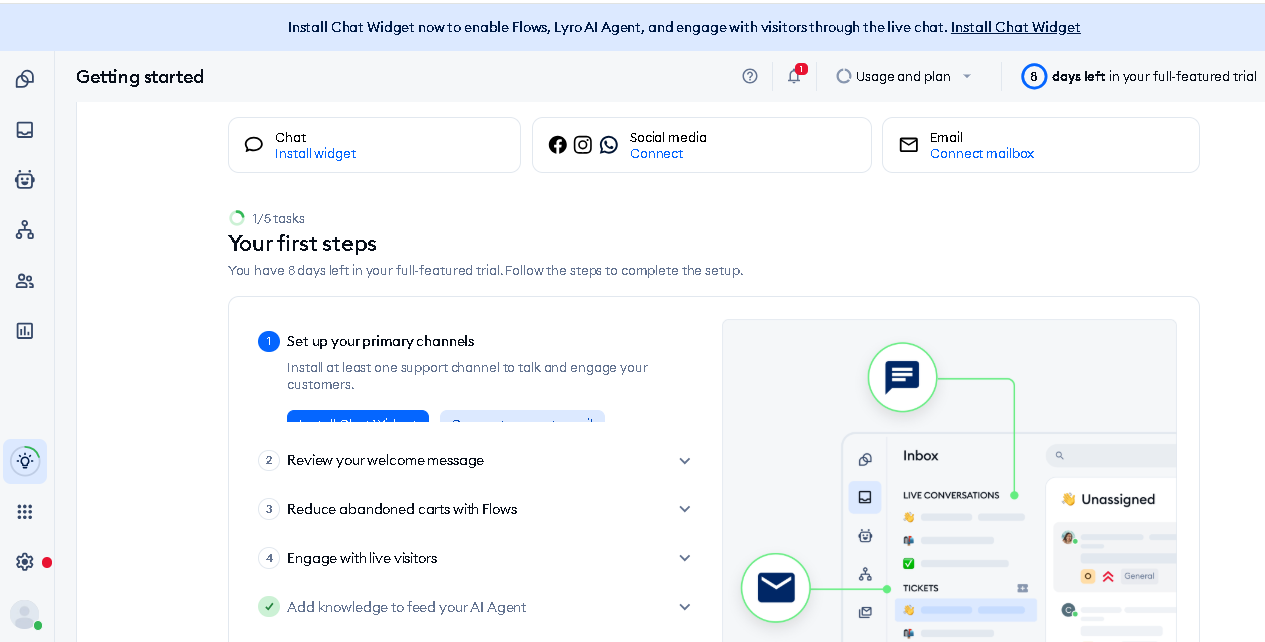
Tidio is a strong choice for ecommerce use cases. With deep integrations for platforms like Shopify, it can access product catalogs and customer data to provide more personalized and conversion-focused support. It helps businesses recover abandoned carts, recommend products in real time, check order status, and guide customers through the buying journey, making it a practical tool for increasing sales as well as handling customer service.
Pros
- Visual flow/drag-and-drop builder with pre-built templates
- Lyro AI add-on for conversational AI support
- Deep Shopify integration; strong for e-commerce
- Free plan available; no credit card required
Cons
- You get 50 free Lyro AI conversations one-time, but costs can increase significantly when you add more Lyro conversations
- Automatic replies require a higher tier
2. Intercom Fin AI — Best Enterprise Chatbot Platform
Intercom's Fin AI is one of the most capable pre-built conversational AIs available in the market. It is built on advanced AI models and can understand and resolve complex customer queries, pull answers from multiple knowledge sources, and maintain context across conversations. It also handles ticket routing and passes more complex issues to human agents with full conversation history and context.
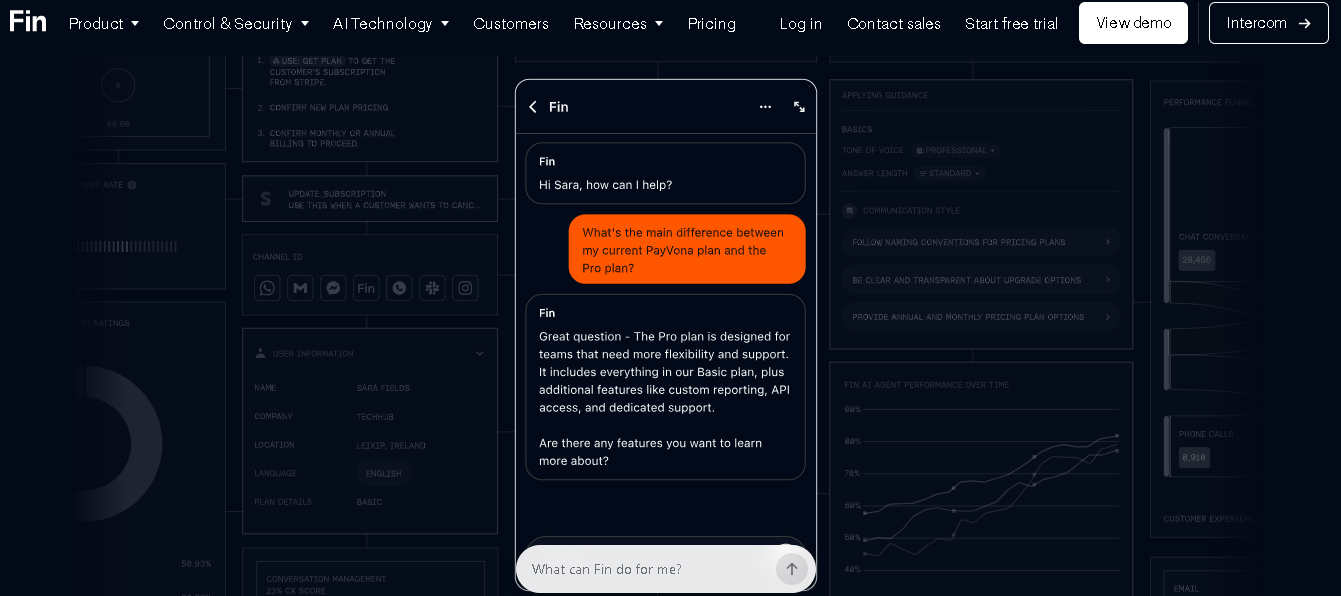
Fin AI agent can triage incoming messages, reduce repetitive support load, and help teams automate customer service efficiently. It is also deeply integrated into Intercom’s broader support suite, which includes an omnichannel inbox, reporting tools, and help center management.
The AI agent can work as customer support, sales assistance, and e-commerce support. In e-commerce use cases, it can answer product questions, guide users through checkout-related queries, and help with post-purchase support.
It’s a solid choice for large teams and enterprises that need a full customer support platform with advanced AI automation and strong human-agent collaboration.
Pros
- Highly advanced AI agent that can resolve complex, multi-step customer queries
- Deep integration with Intercom’s support ecosystem
- Can work as a customer support agent, sales assistant, and e-commerce support agent
- Scalable workflows
Cons
- Expensive compared to most SMB-focused chatbot platforms
- Setup and optimization can be complex for teams without dedicated support operations experience
3. ManyChat — Best Chatbot Builder for Social Media Marketing
ManyChat is the right choice for social media chat automation. It's the go-to platform for businesses running customer engagement and lead generation on Instagram, Facebook Messenger, and WhatsApp. Its Comment-to-DM automation feature messages users who comment on posts automatically, which turns social interactions into automated conversations.
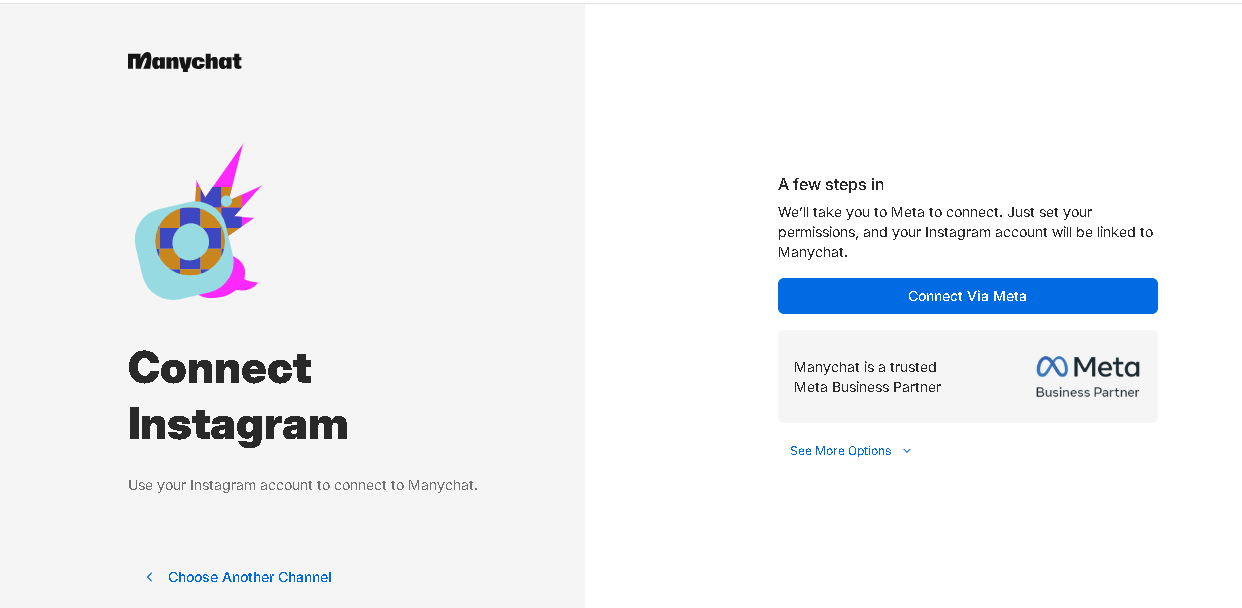
With ManyChat, businesses can also build full marketing funnels directly inside messaging apps. You can capture leads from Instagram stories, keywords, and ads, then automatically qualify users, collect emails or phone numbers, and segment audiences for future campaigns.
It also integrates with tools like Shopify, email platforms, and CRMs so businesses can sync leads and trigger follow-up campaigns outside social media. With its visual drag-and-drop interface, anyone can create complex automation workflows without writing a single line of code.
Pros
- Great Instagram DM and Comment-to-DM automation
- Easy-to-use visual flow builder
- Works across Instagram, Facebook Messenger, WhatsApp, SMS, and email
- Free plan available
Cons
- Mainly a social media tool, not a full website chatbot solution
- Less advanced AI capabilities compared to dedicated web chatbot platforms
4. Botpress — Best AI Chatbot Platform for Developers and Technical Teams
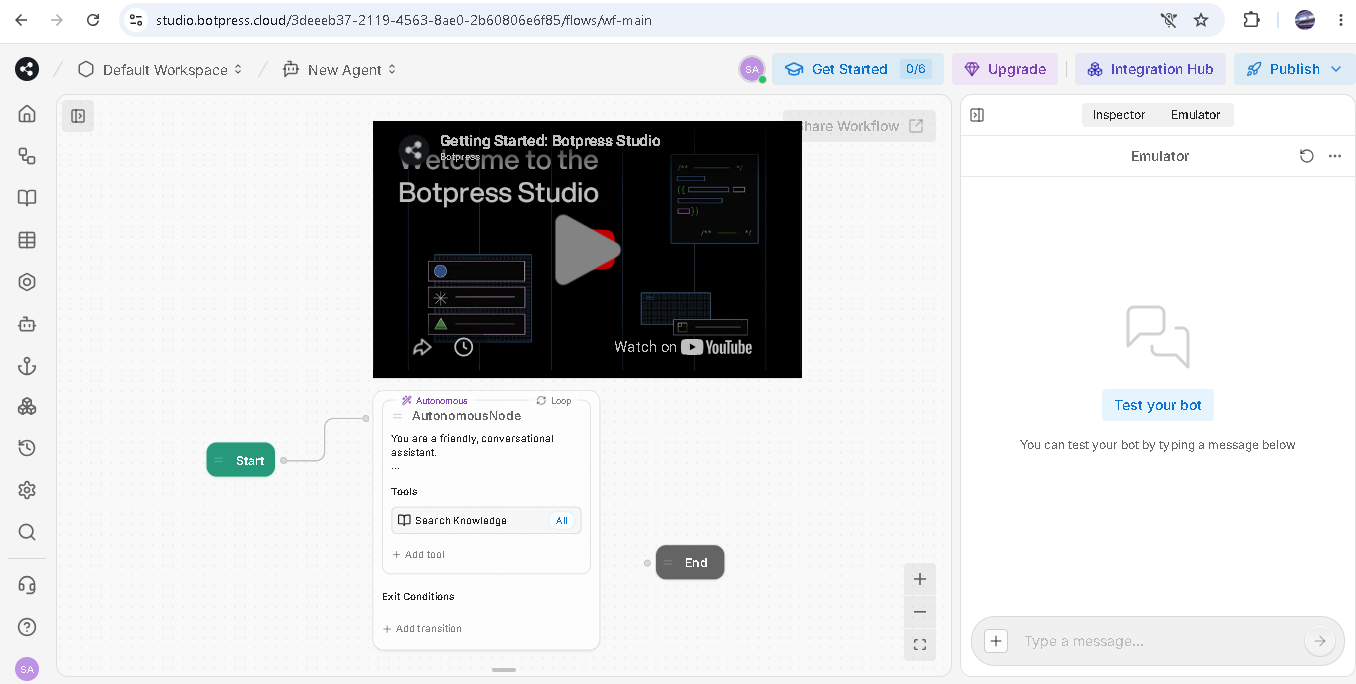
Botpress is the most technically capable no-code or low-code chatbot builder on our list. It’s a great choice for teams that want full control over conversation logic, AI knowledge bases, and deployment configuration. It uses LLM-powered NLP with RAG (Retrieval-Augmented Generation) to train bots on custom data sources.
However, since Botpress is designed for technical teams, it has a steep learning curve.
Pros
- Full control over bot logic and data
- LLM integration with RAG for knowledge-base training
- Strong multi-channel support via API
- Free tier available for exploration
Cons
- Higher learning curve; designed for technical teams
- Hidden costs; costs depend on AI conversation usage
5. Readdy - Best AI Website Builder with Built-in AI Agent
Readdy is the best choice for small businesses wanting to create a website and integrate a chatbot into it. Readdy is an AI-powered website builder that lets you build complete websites with multiple pages, images, and layouts without any technical skills. You describe your business and target audience through prompts, and Readdy creates a professional-looking website within minutes.
The platform also offers a built-in AI agent. When you build a site with Readdy's AI website builder, you can mention it in the prompt to add the agent as well, or you can activate it manually later. There is no separate setup. And the agent comes already trained on your website, so there is no need for manual knowledge base uploads. It reads your content, understands your business, and is ready to talk to visitors the moment your site goes live.
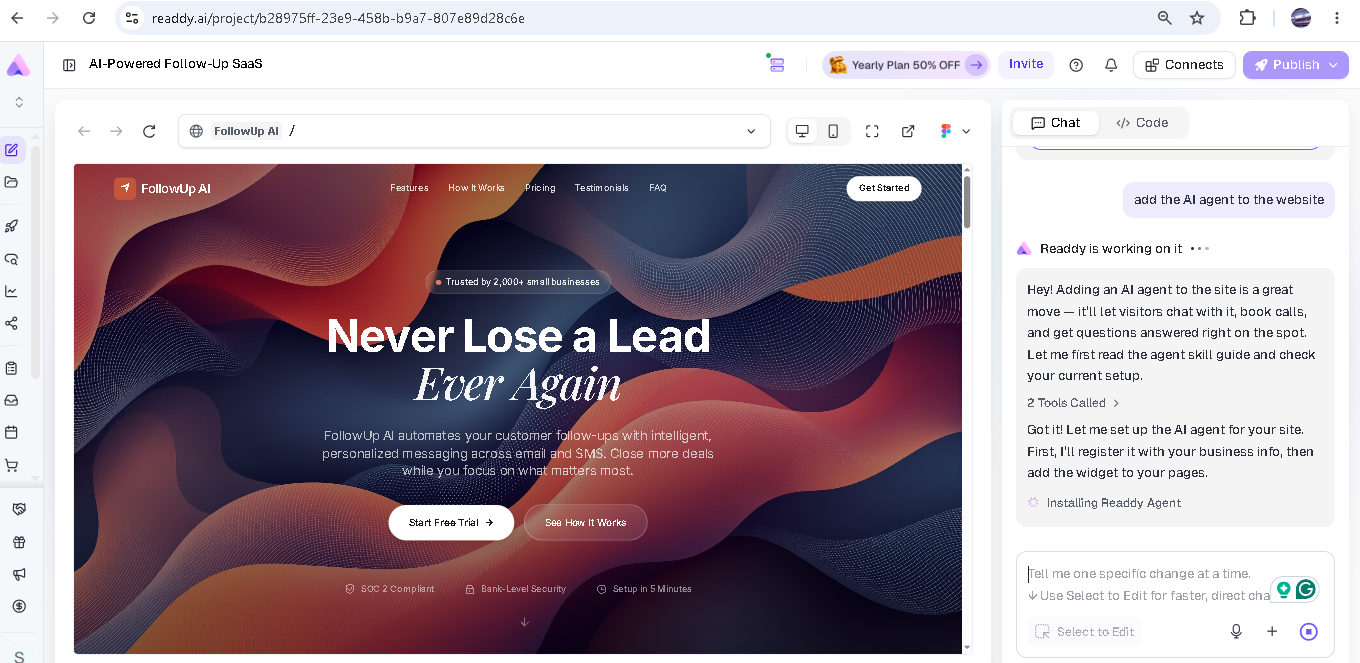
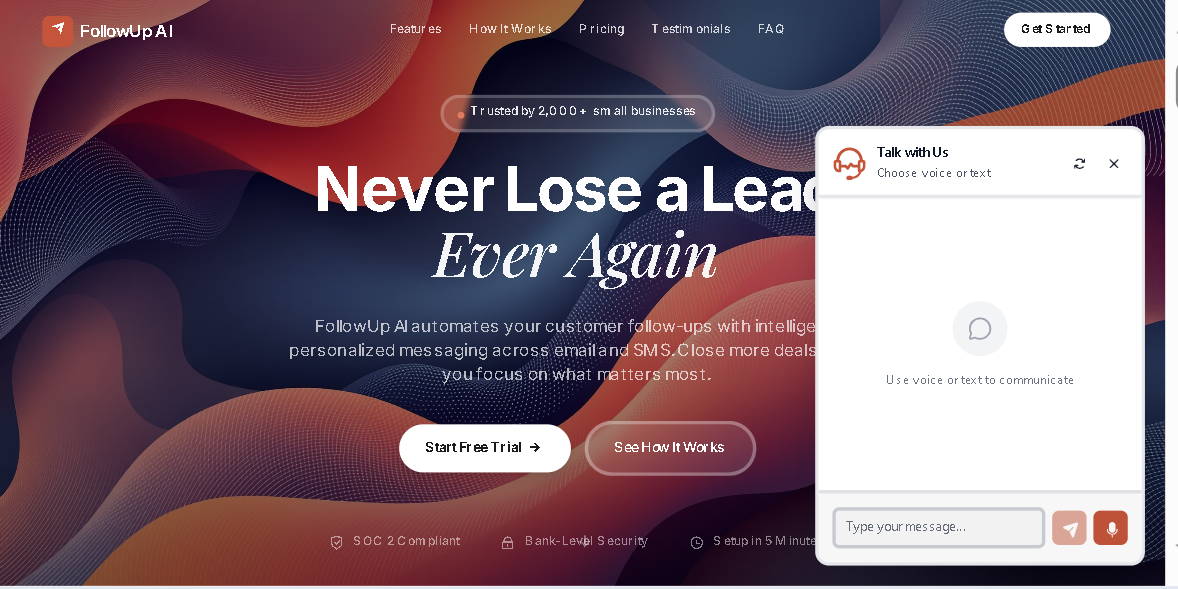
You can also customize or train the agent by adding custom FAQs or providing a set of instructions.
The Agent handles crucial tasks that most small businesses want to automate: answering specific questions that aren't covered in FAQ pages, capturing leads mid-conversation, and booking appointments. It also maintains conversational context across conversations, so even if a customer asks three follow-up questions, they get accurate answers.
Pros
- Launches fully trained on your own website content
- No manual setup required; anyone can configure and adjust it without developer help
- Handles lead capture, appointment booking, and Q&A in a single agent
- Can be customized or trained
Cons
- Built for small business websites, not high-volume enterprise support operations
- Not a standalone product; can only be added to websites built with Readdy
Enterprise-Grade Chatbot Platforms
Enterprise chatbot platforms are built to handle a high volume of queries and complex questions. They also support deeper integrations with other enterprise-grade tools like CRM and marketing tools that smaller tools don’t generally support. These tools can automate across the full customer lifecycle, not just answer FAQs.
The table below shows a quick comparison between the best Enterprise-grade chatbot platforms:
| Platform | CRM Integration | Automation Depth | Scalability | Best for |
| Intercom | Native Salesforce, HubSpot, and Pipedrive integrations | Full lifecycle. Three-layer system:
| Excellent | SaaS and subscription businesses that need support, sales conversations, and customer lifecycle messaging managed from a single workspace |
| Salesforce Einstein | Native Salesforce only - built to work within Salesforce's own ecosystem | Very high. The agent can handle lead qualification, case routing, opportunity management, and customer service end-to-end without human intervention. | Enterprise-grade | Large enterprises that are already fully committed to the Salesforce ecosystem |
| Drift | Salesforce, HubSpot, Marketo, Eloqua, Pardot, Salesloft | High. Automation is focused mainly on converting website visitors into booked sales meetings. | Strong | B2B sales teams running account-based marketing |
| LivePerson | Salesforce, HubSpot, and other CRMs via API, but the setup is quite complex. | Very high. Uses real-time intent recognition and sentiment analysis to route conversations dynamically. | Enterprise-grade | Large enterprises in regulated industries |
No-Code Chatbot Builders for Beginners
No-code chatbot builders let you launch a working bot without writing a single line of code. The best ones have drag-and-drop flow builders or simple configuration interfaces so you can launch a live chatbot in under an hour.
If you’re a beginner, here’s how you can choose a chatbot for a website:
- Define your use case before picking a tool
Before comparing platforms, define what your chatbot needs to do. The right tool depends entirely on your goal. An FAQ bot works differently from a customer support agent.
- Evaluate the interface and ease of use
Check whether the builder offers a true drag-and-drop flow editor and pre-built templates. Evaluate whether a non-coder can easily build a chatbot and avoid tools that require JSON config or code blocks to do basic things.
- Compare tools
Compare the features, interface, and pricing of top beginner-friendly tools, such as Tidio, Landbot, ManyChat, and Readdy AI agent. Pick a tool that offers the features you need, is easy to use, and is budget-friendly.
Tidio is overall the strongest choice for small businesses. The visual flow builder is genuinely easy to learn, and the free plan covers basic use. It also integrates directly with Shopify, WooCommerce, and Mailchimp. Readdy is the best choice for businesses looking to create a website with a chatbot from the ground up.
If your audience is on Instagram or WhatsApp, ManyChat is the right choice.
- Test the tool
Most beginner-friendly chatbot platforms offer a free trial. Before subscribing to a paid plan, sign up for the free trial to test and try the platform.
AI-Powered Chatbot Platforms
AI-powered chatbot platforms go beyond scripted flows. When choosing a chatbot builder, it’s important to know the difference between rule-based chatbots and AI-powered chatbots. They work in different ways and suit different business needs.
Rule-based chatbots are built on fixed sets of answers. When someone sends a message, the bot matches it against a manually built set of keywords and provides a scripted response. For example, if a user types "refund," the bot recognizes that keyword and presents a set of options: "Check refund status," "Request a refund," or "Speak to an agent." If the visitor types something outside the predefined paths, like "I want my money back" instead of "refund," a rule-based bot won’t be able to provide a relevant response.
AI-powered chatbots, on the other hand, use Large Language Models (the same technology behind ChatGPT). These chatbots can understand the intent behind a user's message and provide a contextually relevant response, even when the question is complex.
Here are the key features to consider when choosing an AI-powered chatbot platform:
LLM integration
The quality of responses of AI-powered chatbots depends on the language model it runs on. Many platforms use a single model under the hood, usually GPT-4o or a fine-tuned version, but some platforms also let you choose between multiple providers. For example, you can use Claude for complex customer conversations and a faster, cheaper model for simple FAQs.
If you're using a managed platform like Intercom Fin or Zendesk AI, you'll never touch the model configuration directly. While that's convenient, it also means you're dependent on the vendor every time a better model comes out.
If you're building on a model API directly, you get more control. For example, you can upgrade the moment a new model comes out.
RAG
Retrieval-augmented generation (RAg) is the feature that makes AI chatbots actually useful for businesses. Rather than relying on the model's training data alone, RAG connects the bot to your own content, such as help articles, product documentation, FAQs, and PDFs. It pulls the most relevant information from these sources to provide accurate responses.
Platforms like Tidio (Lyro AI), Intercom’s Fin AI, and Readdy AI Agent support RAG so you can train them on your own knowledge base.
Contextual memory
One of the most useful features of LLM-powered chatbots is that they can remember what you said a few or even several messages ago. You don’t have to explain everything repeatedly. They also notice when the topic shifts and adjust their responses accordingly.
The best platforms, such as Botpress, Intercom Fin AI, and Twilio, extend this with cross-session memory, which means the bot can recall a user's previous interactions, open tickets, or account history when they return.
Human handoff
Most AI chatbots eventually hit a question they can't handle well. How the chatbot handles such situations directly affects the user experience.
The best platforms handle this automatically; the bot hands off the conversation to a human agent with full context. The user doesn't have to repeat themselves. For example, platforms like Tidio, Intercom Fin AI, Botpress, and ManyChat support this feature.
Best Chatbot Builder Comparison Table (Side-by-Side)
Here’s a quick comparison of top chatbot builder platforms:
| Tool | AI Capability | Integration Level | Ease of Use | Free Plan | Pricing |
| Tidio | LLM-based AI agent (Lyro) that can efficiently handle complex queries and retain context | Strong; supports integrations with Shopify, live chat, and CRM | Very easy to use: offers a drag-and-drop builder with templates | Offers a 7-day free trial, which includes 50 Lyro AI conversations | Pricing plans start from $24.17/month (billed annually), but include only 50 Lyro conversations (one-off); costs scale beyond that |
| Intercom Fin AI | Uses GPT-4–class advanced models, pulls data from the knowledge base, and retains full context across conversations.
| Deep integrations with Salesforce, HubSpot, and Pipedrive. Also, integrates seamlessly with Intercom’s native ticketing system | Complex setup; needs a dedicated team | Offers a free trial | Usage-based pricing: $0.99 per resolved conversation, with a minimum of 50 outcomes per month, resulting in a ~$49 monthly base cost for AI usage. Expensive for SMBs when used at scale. |
| ManyChat | Basic; mostly rule-based automation | Supports strong integrations with Instagram, FB Messenger, WhatsApp, and Shopify | Very easy; visual flow builder, no code needed | Offers a free plan, which supports 2 social media channels and basic automations | Pricing plans start from $14 per month, billed annually |
| Botpress | Advanced AI capabilities: LLM with RAG on custom data sources | Can connect to almost any platform through APIs and custom code, such as WhatsApp, Telegram, Messenger, Websites, and Slack. | Steep learning curve; requires technical skills as it’s built for developers | Offers a free plan, which includes 100 conversations and 3 AI agents | Pricing plan starts from $150/month (paid annually), but the cost can increase based on AI usage |
| Readdy | An AI website builder with a built-in AI agent, which is auto-trained on site content and custom FAQs | Can answer specific questions that aren't covered in FAQs, capture leads, and book appointments. Can only be integrated in sites built with Readdy. | Very easy to use; zero setup, no developer needed | Offers a free plan, but it doesn’t support the AI agent | Pricing plans (which include the AI agent) start from $15 per month (billed annually), affordable for small businesses |
How to Choose the Best Chatbot Builder for Your Business
The right chatbot platform depends on your business type and needs. Here's a decision framework based on your business type:
- SaaS companies should prioritize AI resolution rate (how effectively a chatbot can fully solve customer issues without human help), CRM integration (Salesforce or HubSpot), and in-app messaging. Tidio is a go-to tool for small to medium-sized SaaS companies, Intercom is the best choice for enterprise-grade companies, and Botpress is a solid option for technical teams.
- E-commerce stores need chatbots that support product catalog integration, cart abandonment flows, and deep integrations with Shopify or WooCommerce. Tidio is the best choice with its native Shopify integration, ecommerce-specific templates, and ease of use.
- Agencies building chatbots for clients need features like white-labeling, multi-account management, and flexibility across industries. Botpress is a great option for such use cases. Voiceflow is also a strong choice for agencies that build client-facing bots across both web and voice channels.
- Startups need a budget-friendly chatbot that can handle basic tasks. Tidio's free tier gets a functional chatbot live in an hour that can help you understand customers' queries before investing in paid plans with complex flows.
Chatbots + AI Website Builders: The Modern AI Stack
Chatbots and AI website builders are becoming essential tools in businesses’ modern AI stack because they solve two different problems: creation and conversion. AI website builders help generate fast, production-ready websites from simple prompts, handling layout, structure, content, and responsive design in minutes. Once the website is live, chatbot tools turn static pages into interactive experiences, allowing visitors to ask questions, get guidance, and move toward conversion in real time.
Why Your Website Builder Matters
A chatbot is only effective if your website is fast and properly designed. Customers quickly leave slow websites with poor layouts, reducing chatbot engagement before the conversation even starts.
Modern AI website builders help solve this problem by allowing businesses to generate complete, professional websites in minutes and iterate quickly using AI prompts. The best AI website builders create mobile-optimized websites with responsive design and clean layouts.
A fast, well-designed website built on a reliable AI website builder improves the overall user experience and increases the likelihood that visitors will engage with the chatbot.
Introducing Readdy AI Website Builder in Modern AI Stacks
Readdy is an AI-powered website builder that lets you create mobile-optimized, professional websites with multiple pages and proper layouts in minutes through prompts. Rather than requiring you to sign up for a separate chatbot service and embed a third-party widget, Readdy allows you to deploy its built-in Agent with your site from day one.
The Readdy AI chatbot for websites is a 24/7 AI agent that engages site visitors, answers questions, captures leads, and books meetings. When you integrate the agent, it is already trained on the site’s content and business information, and it supports both chat and voice interactions. It can also send notifications and trigger workflows through integrations, helping teams stay updated on new bookings or inquiries.
The agent also supports multilingual conversations, customizable behavior through prompts, and integration with external tools like calendars and CRM systems.
For business owners who are looking to create a website and don't want to manage a separate chatbot subscription or integrate multiple tools, Readdy is the best choice. Its built-in AI Agent is the only chatbot for websites that is natively included in an AI website builder, combining site generation, hosting, and 24/7 AI-powered visitor engagement in a single platform.
Implementation Guide: How to Set Up a Chatbot on Your Website
Here's a quick guide for deploying a chatbot on your website:
Step 1: Choose your platform.
Use the comparison table and decision framework above to select the tool that fits your business type, use case, and budget. If you're building a new website, it’s best to start with Readdy to get a built-in chatbot that doesn’t require any separate setup.
Step 2: Define your chatbot's primary job.
Don't try to make it do everything at once. Start with one goal: answer the top 10 FAQs, capture leads, or book demo calls.
Step 3: Train it on your content.
For AI-powered platforms (Botpress, Tidio Lyro), upload your FAQs, pricing page, product documentation, and any other relevant content. The more context the bot has, the more accurate its responses.
Step 4: Build your conversation flows.
Use the visual editor to create the core flow: Most platforms provide templates for common use cases. You can use these templates as a starting point instead of starting from scratch.
Step 5: Embed on your website.
Copy the embed script and paste it into your site or use your platform's native plugin. For Readdy users, the Agent is already built in: you can quickly add it to your site through a single prompt.
Step 6: Test before going live.
Test different conversation paths manually and check how the chatbot responds when the user asks something outside the training data. Also, ensure that the handoff to a human agent works correctly.
Step 7: Launch and monitor.
Track metrics like conversation volume, resolution rate, and drop-off points. Most platforms provide these in the dashboard.
Step 8: Integrate with your CRM.
Connect to your CRM like HubSpot or your email tool on day one. Every lead the chatbot captures should automatically go into your pipeline.
Common Mistakes When Choosing a Chatbot Builder
- Choosing an overly complex tool. Intercom is a great chatbot builder, but if you're a startup with a small team and only need to answer simple FAQs through a chatbot, you likely don’t need it; you can use a simpler tool like Tidio.
- Ignoring integration limits. Before you commit, check whether the platform integrates with your actual CRM, not just Zapier. Many platforms advertise integration capabilities that require lots of manual steps to set up.
- Overlooking AI capabilities. Rule-based bots are cheaper, but they frustrate users. Customers now expect conversational responses, making it essential to choose an AI-powered chatbot platform that can understand and maintain context and provide accurate responses across conversations.
- Overlooking hidden prices. Many platforms charge based on AI conversation usage. They offer a fixed number of conversations in the selected plan and then charge extra for excess usage, which can burn through your budget quickly.
Frequently Asked Questions
What is the best chatbot builder?
Tidio is the best all-in-one chatbot for small businesses that need to add a chatbot to their existing websites. Intercom is the best enterprise chatbot platform. ManyChat leads for social media and WhatsApp automation. For businesses building a new site and wanting to add a chatbot to it, Readdy is the best tool, as it includes a built-in AI chatbot agent with no separate subscription required.
Do I need coding skills?
No. Tools like Tidio and ManyChat can be set up and deployed in under an hour without technical knowledge. You can add the Readdy AI agent to your website within a minute with a simple prompt in plain language.
Which chatbot is best for websites?
Tidio is the best chatbot for existing websites because it can be installed in minutes, is super easy to use, and offers an AI-powered chatbot. Readdy is the best choice if you’re building a new website and want to add a chatbot to it.
Are AI chatbots better than rule-based ones?
Yes, in most cases. AI chatbots can understand the context and provide accurate and relevant answers across chats.
Final Verdict
In 2026, the question is no longer whether your website needs a chatbot: it’s which chatbot builder fits your workflow, your budget, and your customers.
Here's the summary of the best tools for different use cases and business types:
- Best for small business websites: Tidio (free plan available; great Shopify integration)
- Best for enterprise and SaaS: Intercom with Fin AI (high resolution accuracy)
- Best for social media and WhatsApp: ManyChat (free plan; best Meta integrations in the market)
- Best for developers and custom builds: Botpress (LLM + RAG; full control)
- Best for businesses creating a new website and want to add a chatbot to it: Readdy (AI website builder + built-in AI Agent; no separate chatbot subscription needed)
Looking to create a new website quickly and want to add a chatbot to it with a simple prompt? Sign up for Readdy to get started!
Kael
Kael is an editor and content strategist covering AI tools, website creation, and online growth. Interested in how people build and share on the internet, Kael writes practical content around digital products and modern web experiences.