







How to increase your website traffic in 2026
Published:
Updated:
Learn how to increase website traffic in 2026 with SEO, content, AI search, email and local listings, and how to tell which new visitors become customers.
Kael is an editor and content strategist covering AI tools, website creation, and online growth. Interested in how people build and share on the internet, Kael writes practical content around digital products and modern web experiences.
If you'd like more people to find your website, you're probably hoping for more of the right visitors too, the ones who might buy something or get in touch. Learning how to increase website traffic is mostly about making your site easy to find in the places those people already look, which for most businesses means Google, AI tools like ChatGPT, social media and their email inbox.
Search has changed a fair bit over the last couple of years. In the first four months of 2026, 68% of Google searches in the US ended without a click, either because people found their answer on the results page or because they searched again. Organic search still brought in 42.75% of all website visits across the 101,574 sites SE Ranking studied this year, though, compared with 0.32% from AI platforms.
Most of the work is free to do yourself. It starts with fixing anything that stops your pages from being found and building pages around what people are searching for. After that, it's a case of sharing your work where your customers spend their time and checking which visitors go on to get in touch. If you look after websites for clients, the same steps work just as well for theirs.
Quick answer:
To increase website traffic, start by fixing anything that stops Google from finding and showing your pages, like slow loading or pages that aren't indexed. Then build pages around what people are searching for and keep your best ones up to date, while earning links and mentions from other websites. Write clear, direct answers that AI tools can quote, and share your content by email and on social media, with paid ads for when you need visitors quickly. Measure progress in Search Console and GA4 by the enquiries and sales your visitors bring in, alongside total visits.
Key takeaways
- Increasing website traffic in 2026 means attracting qualified visitors and being quoted in AI answers, now that 68% of US Google searches end without a click.
- Fix indexing and page speed problems before chasing more visitors, because extra traffic to a slow or broken page is mostly wasted.
- The most reliable way to increase website traffic organically is to give each search intent its own useful page, keep your best pages up to date and earn links from trusted sites.
- When you're working out how to increase your website traffic, measure progress in Search Console and GA4 by the enquiries and sales it brings in.
What increasing website traffic means in 2026
Increasing website traffic in 2026 means getting more of the visitors who are likely to become customers, and showing up in AI answers as well as in Google's list of results.
A post about a viral trend can bring in thousands of visitors who leave after a few seconds, and we'd call that vanity traffic, because it looks good on a chart and does very little for the business. Qualified traffic comes from people searching for something you sell or a problem you solve, and a few hundred of them will usually bring in more business than thousands of the other kind.
The other change is where people find answers. Google's AI Overviews now sit above many search results, and tools like ChatGPT and Perplexity answer questions directly. In a Pew Research Center study, people clicked a result on 8% of visits when an AI summary appeared, compared with 15% when there wasn't one, and getting your pages quoted in those summaries is now part of the job.
Fix the foundations before chasing more traffic
Before you work on getting more visitors, make sure Google can find your pages and that the people who arrive have a good experience, since extra traffic sent to a slow or broken page tends to leave straight away.
Start with these checks:
- Open Google Search Console, which is free, and use the URL Inspection tool on your most important pages to confirm they're indexed, meaning Google has stored them and can show them in results.
- Look at your Core Web Vitals, which are Google's measures of how quickly a page loads and responds. Google wants the main content to appear within 2.5 seconds, and only 48% of websites pass all three measures on mobile.
- Test your pages on a phone, because Google uses the mobile version of your site for indexing and ranking.
- Give every page a unique title, a short description and one clear main heading, and fix or redirect any broken links.
On a new site, your platform decides a lot of this for you. A site made with Readdy's AI website builder comes with compressed images, layouts that adjust to phones automatically, a sitemap and a one-step connection to Google Search Console, which covers most of these checks before you publish.
How to increase website traffic organically
If you're wondering how to increase website traffic organically, meaning through unpaid search results and AI answers, the answer is to publish pages that match what people search for and make them easy for Google to read, while earning links and mentions from other websites.
Create content that matches search intent and AI search
Search intent is the reason behind a search, and a page ranks best when it gives people the kind of answer they came for. Someone searching "how much does a kitchen remodel cost" wants a price range, while someone searching "kitchen remodelers near me" wants a list of local businesses and a phone number.
The best phrases to target are usually longer and more specific, which we call long-tail keywords. "Accountant" is a head term searched by people with very different needs, and you'd be competing with every accounting firm in the country. "Accountant for freelance photographers in Denver" gets far fewer searches, but the people typing it know exactly what they want.
To find phrases like that, type a seed keyword, meaning the simplest word for what you do, into Google and look at the People Also Ask questions. Then check the Queries report in Search Console for searches you already appear for, and note the questions customers ask you by phone or email. Give each search intent its own page with the answer near the top, and AI tools will have a clear passage to quote as well.
On-page and technical SEO that still makes a difference
On-page SEO helps Google understand each page, and the basics still decide a lot of rankings. On every important page, check the following:
- A title under about 60 characters with the main phrase near the start, and a description of 120 to 158 characters.
- Headings in a clear order, with one main heading and subheadings that describe each section in plain words.
- Internal links between related pages, which show Google which pages count most.
- Schema markup, which is code that labels facts like your opening hours, prices or FAQs, making them easier for search engines and AI tools to read.
- A sitemap submitted in Search Console, so Google can crawl every page you'd like found.
Publish and refresh content that earns clicks and links
Evergreen content stays useful for years and brings in steady traffic, while timely content about news or trends gives you a short spike, and most websites do best with plenty of the first and a little of the second.
Some content attracts links naturally, especially original data like a survey of your customers, and free templates or checklists that people find handy to share.
Refreshing old pages is often the quickest answer to how to increase traffic to website pages you already have. Compare the last three months with the same period a year earlier in Search Console and look for pages that have lost clicks. Updating the facts and adding anything a newer competitor covers will often bring them back up.
Build landing pages for high-intent searches
A landing page is built around one specific search and one action you'd like visitors to take, which makes it the page most likely to turn a visit into an enquiry. Service pages, location pages, comparison pages and use-case pages are the most useful types, as long as each one gives people information they can't get elsewhere on your site and one obvious next step, like a booking form.
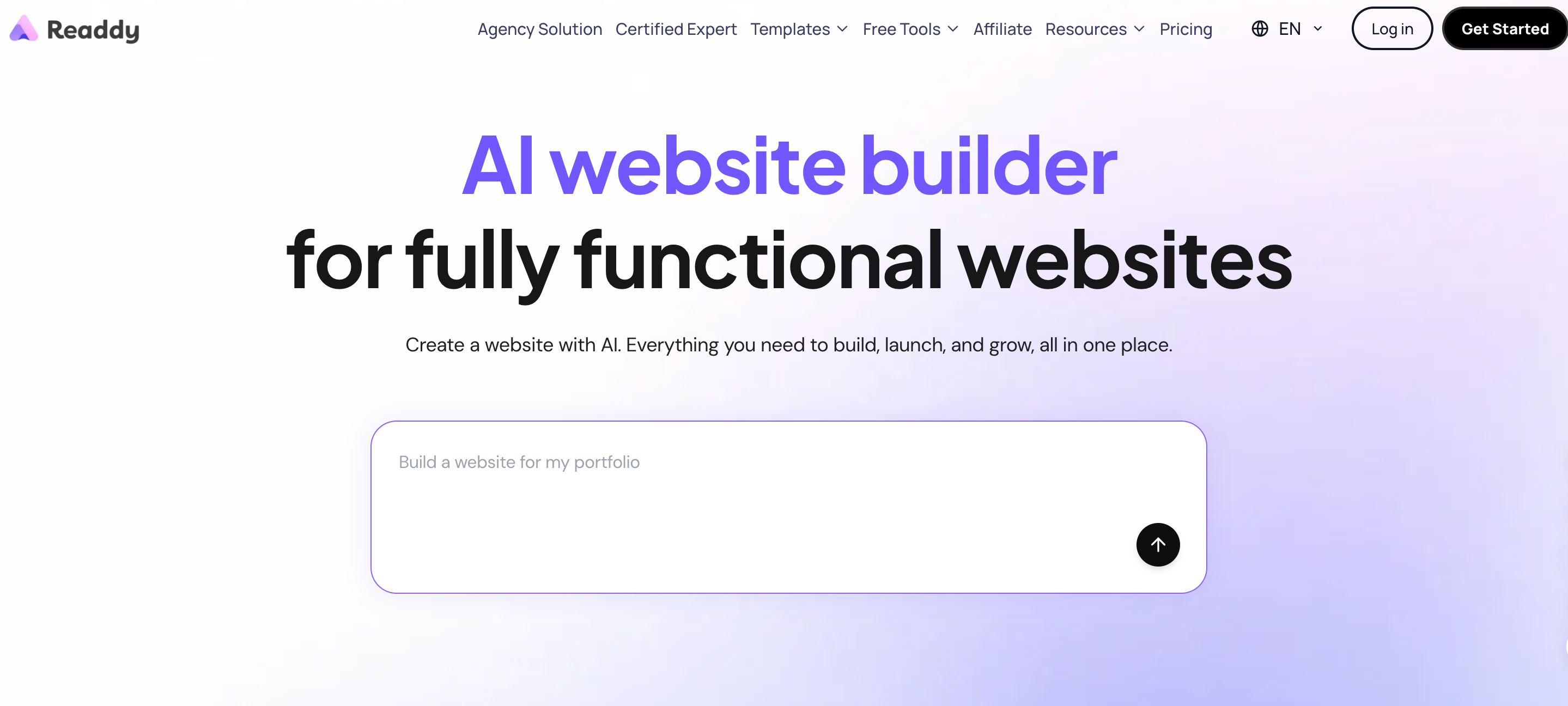
With a no-code AI website builder like Readdy, you can describe the page you need, have a working draft in a few minutes and then edit it by asking for changes in plain words. The speed only helps if each page says something useful, though, so spend your time on the details only you know, like your prices and examples of your own work. Our guide on how to build a website from text with AI shows how to get a strong first draft.
Earn quality backlinks and brand mentions
Backlinks are links to your website from other websites, and a handful from trusted, relevant sites will help you far more than hundreds from low-quality ones. When Ahrefs looked into why 96.55% of pages get no traffic from Google, a lack of backlinks was one of the two main reasons.
The links that last are the ones people choose to give you. Original research gives journalists something to cite, and suppliers and trade associations often list the businesses they work with. Offering expert comments to journalists, usually called digital PR, can earn links from news sites too. Mentions of your brand count even without a link, especially for AI search, because AI tools build their picture of which businesses to trust from what other websites say about them.
Show up in AI search with GEO
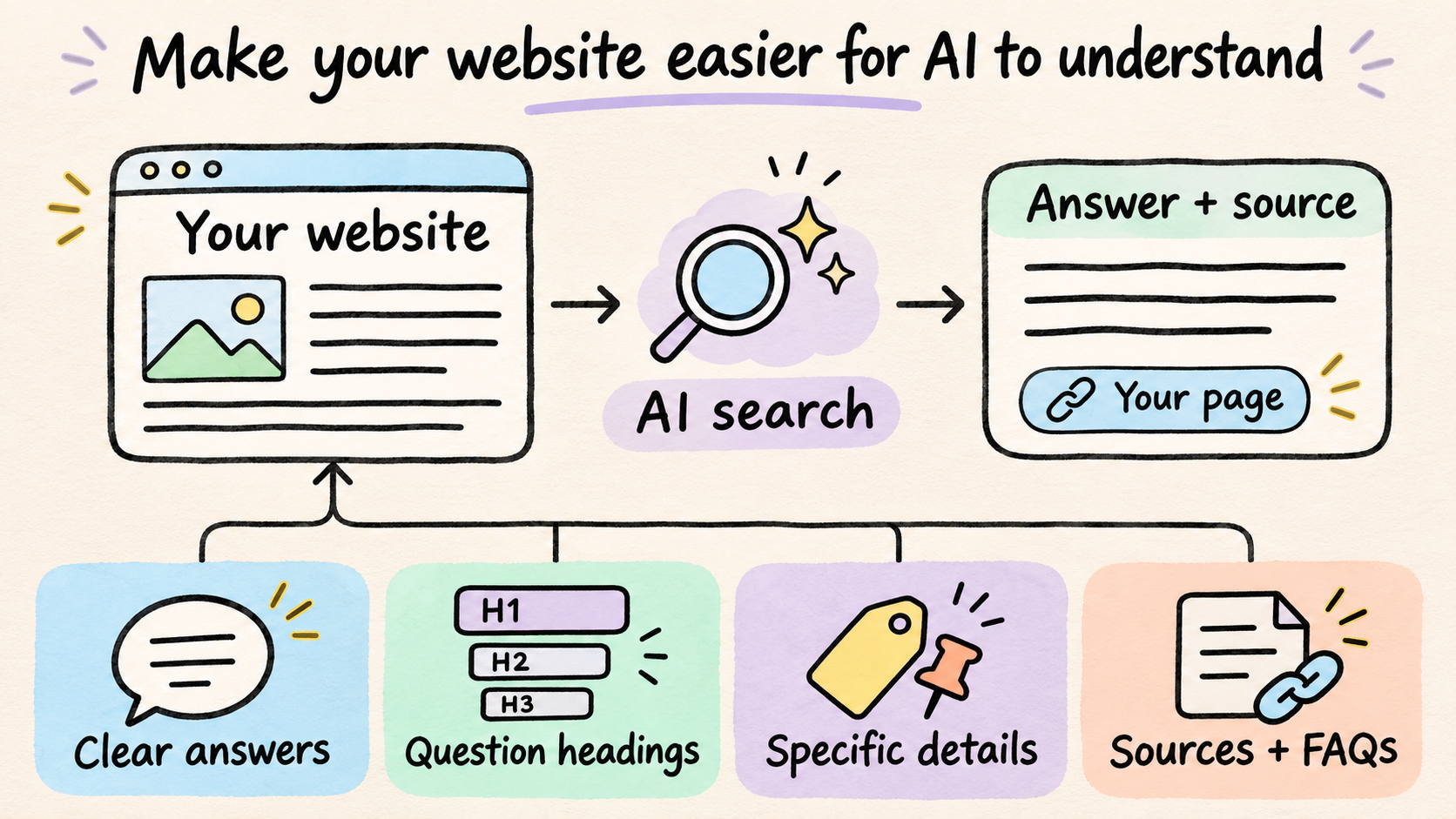
GEO, or generative engine optimization, means making your website easy for AI tools like ChatGPT and Google's AI Overviews to find, understand and quote. Google says there are no extra requirements to appear in AI Overviews beyond the usual Search basics, and good SEO already covers most of it
A few habits make your pages easier for AI tools to use:
- Start each section with a clear one or two sentence answer to the question in its heading.
- Use descriptive headings that match how people phrase questions.
- Name specific products, places and prices in place of vague descriptions.
- Link each fact to where it came from, and add an FAQ section for the questions customers ask most.
You can track visits from AI tools in GA4 by looking for referrals from chatgpt.com and perplexity.ai. They make up just 0.32% of all website traffic for now, although SE Ranking found those visitors spend 68% more time on a site than visitors from organic search.
Some website builders now include GEO tools. Readdy's AI Visibility feature updates your GEO files and page schema each time you publish, and you can see how your current site looks to AI search with the free GEO Score Checker on Readdy's ai website generator tools page. With any GEO tool, check what it changes on your site before you rely on it.
Other channels that increase traffic to your website
Search brings in the steadiest traffic, and knowing how to increase traffic to your website beyond Google helps you reach people who aren't searching yet, some of whom will later link to you or search for you by name.
Social media and community participation
Social media works best when you share useful things where your customers already spend time and answer their questions there too. LinkedIn suits most business services and Instagram suits anything visual, while Reddit and industry forums are good places to answer questions in your field. Pick one or two platforms and post regularly, since a steady presence on one channel brings in more visitors than an occasional post on five.
Email as a traffic channel you own
Email is the one channel you fully own, because search engines and social platforms can change how they work overnight while your list stays yours. Offer something useful in return for an email address, like a checklist or a discount, then send regular emails that each link to a specific page on your site. Adding UTM tags to those links, which are short labels on the end of a web address, lets GA4 show you how much traffic each email sends.
Local search and directory presence
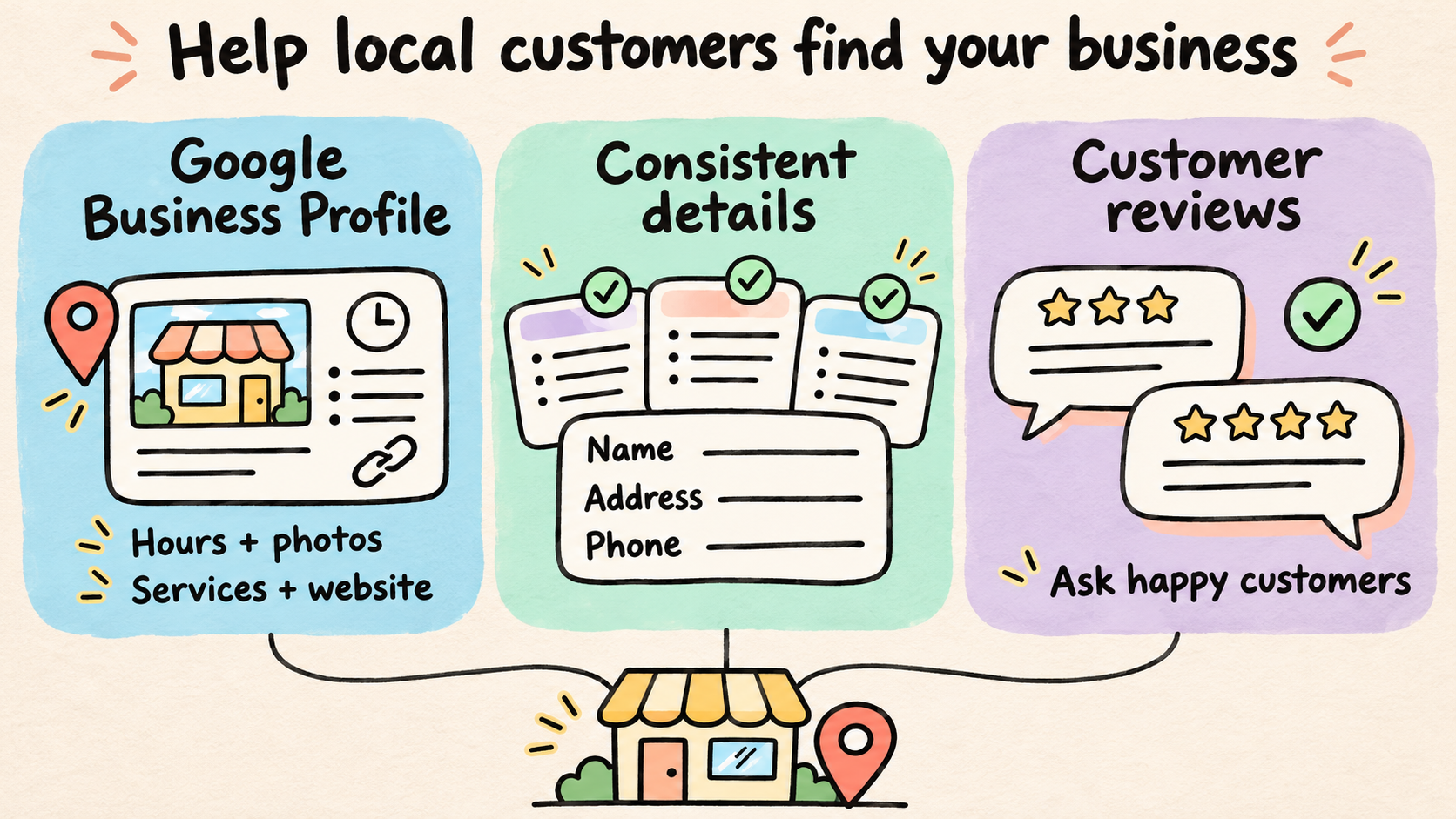
If you serve customers in a particular area, your Google Business Profile is often the first thing they see. BrightLocal found that 52% of consumers started their most recent local search on Google, and 45% have now used an AI tool to find a local business, up from 6% a year earlier.
Claim your Google Business Profile and fill in your hours, photos, services and website link. List your business on the main directories for your industry with the same name, address and phone number everywhere, and ask happy customers for reviews, since 97% of consumers read reviews for local businesses.
Paid and hybrid ways to increase website traffic quickly
Paid advertising is the quickest way to increase website traffic, because ads can appear within hours, but the visits stop when you stop paying. It works best alongside organic work, to promote a launch or bring in visitors while your SEO builds. The average Google Ads search click costs $5.42 in 2026, with an average cost per lead of $66.69, although both vary a lot by industry.
Hybrid options sit somewhere in between, like boosting a social post that's already doing well or sponsoring a newsletter your customers read. Send paid visitors to a landing page built for that ad, which will turn far more of them into enquiries than your homepage would.
Measure traffic quality and diagnose a stall
To measure traffic quality, use Google Search Console for what happens before the click and GA4 for what happens after it. Looking at the two together tells you if you have a visibility problem or a website problem.
Search Console shows how often your pages appear and get clicked, and GA4, or Google Analytics 4, shows what visitors do once they arrive. Set up key events in GA4 for the actions you care about most, like a form submission or a purchase. When traffic stops growing, this table points you to the likely cause.
Common mistakes that waste time and traffic
Most traffic problems come from a handful of habits, and the most common is chasing volume over relevance. Big, broad keywords usually bring in visitors who aren't looking for what you sell, while a smaller, more specific search with a clear need behind it nearly always brings better results.
Neglecting technical health holds back even good content, and publishing without promotion leaves new pages waiting months for visitors when an email or a social post could give them a head start.
Ignoring measurement makes every other decision harder, because without key events in GA4 you can't tell which visitors become customers. Relying on a single channel leaves you exposed when it changes, which is what AI Overviews have done to many websites, and keeping search and email working side by side gives you a steadier base.
Frequently asked questions
How can I increase website traffic fast?
The fastest ways are paid ads, which can send visitors within hours, and sharing your content with an email list or social following you already have. For quick organic gains, improve pages that rank just outside the top ten in Search Console, since small changes to those pages can move them onto the first page within weeks.
How long does it take to increase website traffic?
Paid ads and email can increase website traffic within days, while SEO usually takes three to six months to show clear results, and longer in competitive markets. Ahrefs found that most pages reaching Google's top ten took between two and six months to get there, which makes it sensible to start the organic work early.
Is SEO still worth it with AI search?
Yes. Organic search still brought in 42.75% of all website visits in SE Ranking's 2026 study, compared with 0.32% from AI platforms. AI tools also draw on pages that already rank well in search, which means the same work that improves your rankings makes you more likely to be quoted in AI answers.
Do I need a developer to improve SEO?
Usually not. Most SEO work, like writing better content, improving titles and descriptions and earning links, needs no coding at all. An AI website builder for small businesses like Readdy also handles the technical side, including fast loading, mobile layouts, sitemaps and schema. A developer is helpful for custom code problems or a large site migration.
What is the best AI website builder for SEO?
The best AI website builder for SEO handles the technical basics for you and leaves you full control over your content. Readdy creates fast, mobile-friendly pages with structured data and a sitemap, connects to Search Console in one step and adds GEO tools for AI search. Its templates show what ai website builders for beginners can produce.

Kael
Kael is an editor and content strategist covering AI tools, website creation, and online growth. Interested in how people build and share on the internet, Kael writes practical content around digital products and modern web experiences.