How many websites are there: Stats to Know in 2026
Discover how many websites are there in 2026, from total counts to active sites, top-visited platforms, and the rise of AI website builders.

Frank Zhu
Frank is the founder of Readdy.ai. A developer-turned-founder with 10+ years of product experience, Frank loves great design, and he's building the tools he wishes he had when launching his first startup.
The internet has never been bigger, with millions of live websites. And it keeps growing. Every day, hundreds of new websites go live, increasing the total number of websites. Businesses launch online stores, creators publish blogs, companies build websites to generate leads, and startups build SaaS platforms. Things are speeding up even more thanks to AI website builders. Anyone can now create a professional-looking website with just a few prompts in plain English.
But how large is the web really, and how many websites are there in the world? The numbers are staggering. While there may be over a billion total websites worldwide, not all are active. In this article, we’ll provide all the key stats related to the current state of the internet in 2026.
Total Number of Websites Stats
Here’s a quick overview of the most important website statistics in 2026:
- As of March 2026, there are around 1.43 billion total websites globally, up from around 1.2 billion in 2021. (Netcraft, Siteefy)
- Only 15% of all websites are active, meaning roughly 208 million sites are actually live and serving content. The other 85% are parked domains, inactive pages, or abandoned projects. (Siteefy)
- Around 546,606 new websites are created every day. That's roughly 380 new sites every minute. (Siteefy)
- There are around 392.5 million total registered domains worldwide, a number that keeps climbing as more businesses realize that an online presence isn't optional anymore. (Siteefy)
- As of early 2026, just over half of all global website traffic (52.27%) comes from mobile devices, down from 62.39% just a year earlier. ( Statista)
- There are roughly 28 million e-commerce websites worldwide as of 2026, up 2.9% from 2024, reflecting the continuous rise of the e-commerce industry ( SellersCommerce)
- Google still dominates the global search engine market with 91% of all searches worldwide and over 8.5 billion searches per day. ( Colorlib)
- The global AI website builder market grew from $2.69 billion in 2025 to $3.24 billion in 2026, a 20% jump in a single year, and it’s expected to reach approximately USD 17.43 billion by 2035, reflecting that AI-powered website creation is the future. (Precedence Research)
- 67.39% of business owners now prefer to use AI website builders instead of traditional website development from scratch. (Gauss)
How Many Websites Are There on the Internet?
The short answer is that there are around 1.43 billion websites worldwide (Siteefy).
- 546,606 are added to the web every day
- 22,775 new sites go live every hour
- Around 380 new sites are created every minute, and 6 new sites per second
The web has gone through extraordinary cycles of growth and contraction in the past two and a half decades. In 2000, there were only around 17 million websites. Today's total is roughly 75 times larger. (Internet Live Stats, Siteefy)
The web first crossed the 1 billion website mark in 2014, and peaked at 1.7 billion in 2017. But interestingly, there was a decline in the total number of websites for some years before the number started to increase again. (Internet Live Stats)
In 2021, there were roughly 1.2 billion total websites, much lower than peak estimates of 1.7 billion in 2017. From there, the numbers fluctuated over the years.
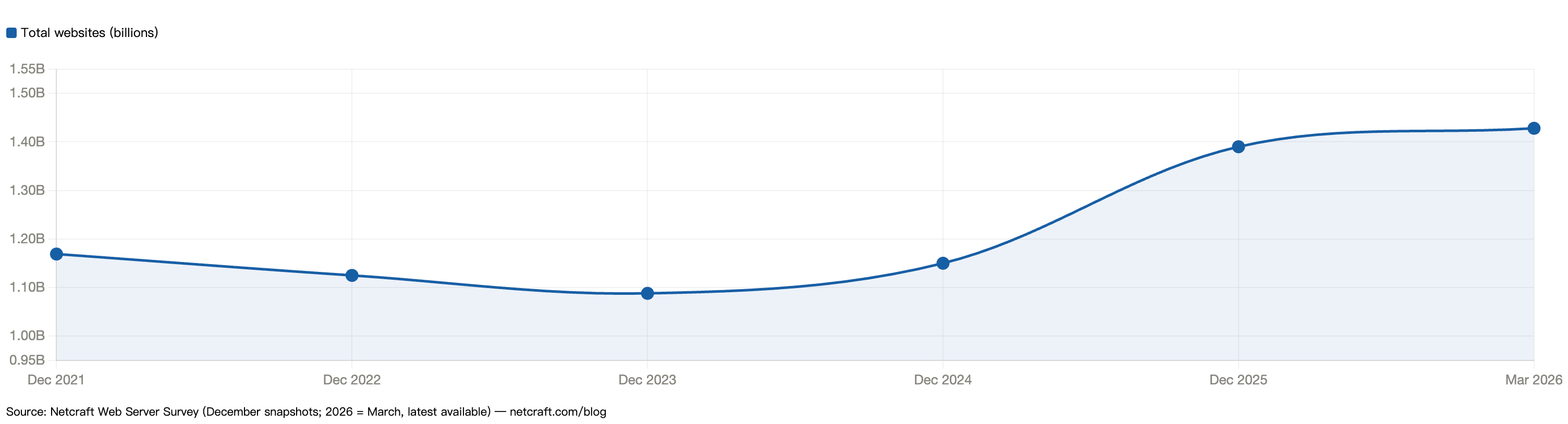
One of the reasons for the recent increase is the rise of AI website builders. They’ve made it easier than ever to create professional websites without technical skills.
How Many Active Websites Are There
While the total number of websites may be over 1.4 billion, that number alone tells only part of the story. It shows the total number of websites created, but not all of them are active and serving content.
In fact, only 15% of all websites are active, which means roughly 208 million sites are actually live and maintained regularly. The other 85% are inactive pages, parked domains, or abandoned projects.
| Status | Estimated Number | Share of Total |
| Active websites | 208 million | 15% |
| Inactive websites | 1.22 billion | 85% |
| Total | 1.43 billion | 100% |
(Source: Siteefy)
Keeping a website active matters more than most people realize. An abandoned or neglected site can damage SEO rankings and weaken customer trust. Websites that are regularly updated with fresh content, working links, and fast load times perform much better in search results and convert more visitors into customers.
The striking difference between active websites and total websites shows that many people are only registering domains with placeholder pages. They are not actually building a complete website. Future business ideas, side projects, and abandoned plans all add to the inactive pile.
But a big part of it is also because many people find building and maintaining a website a time-consuming and costly process. Readdy AI makes this part simpler and easier.
Readdy is an AI-powered website builder that lets you create production-ready websites within just a few minutes through prompts in plain English. You describe what you want to build, and your target audience, and the platform creates the complete website with multiple pages, images, and layouts within a matter of a few minutes. And the website is also mobile-optimized by default.
Readdy also supports real-time prompt-based editing. Once you have your website, you simply provide prompts for what you want to edit, and the platform makes changes instantly. Its built-in SEO tools handle metadata, sitemaps, and indexing, keeping your site active and performing well so you don't need a dedicated developer or SEO specialist.
With Readdy, you also don't have to worry about security certificates, domain setup, or technical maintenance. The platform provides built-in hosting and custom domain support and handles all the technical setup on your behalf.
The Most Visited Websites in the World
The internet may have over a billion websites, but most of the world's traffic flows to just a few of them. Here are the top 10 most visited websites globally as of early 2026, based on monthly traffic data:
| Position | Website | Category | Monthly Visits |
| 1 | google.com | Search Engine | 111.75 billion |
| 2 | youtube.com | Video Platform | 54.4 billion |
| 3 | facebook.com | Social Media | 10.85 billion |
| 4 | instagram.com | Social Media / Photo Sharing | 7.16 billion |
| 5 | chatgpt.com | AI Assistant | 6.19 billion |
| 6 | reddit.com | Community Forums | 5.76 billion |
| 7 | wikipedia.org | Reference / Encyclopedia | 4.87 billion |
| 8 | x.com | Social Media | 4.44 billion |
| 9 | whatsapp.com | Messaging | 3.06 billion |
| 10 | yahoo.com | News / Search | 2.56 billion |
(Source: Semrush)
The table clearly shows that search engines and social media platforms are ruling the web, with Google getting the most monthly visits of 111.75 billion, and social media platforms (Facebook, Instagram, X, and Reddit) getting a combined monthly traffic of 28.21 billion.
An interesting thing is the presence of ChatGPT among the world’s most visited websites, with 6.19 billion monthly visits. The platform went from zero (launched in 2022) to over 6 billion monthly visits in just over three years. It shows just how quickly AI tools are becoming something people rely on daily.
How Many Websites are There in Google
Many people mix up the total number of websites on the internet and the number of pages Google has actually indexed. These are two very different things, and the numbers are nowhere near the same.
Google currently has 3.98 billion (measurable) indexed public pages, but the total number of websites is 1.43 billion (Siteefy). The huge difference in numbers is because Google indexes pages, not just entire websites, and a single website can have numerous pages.
But even with billions of pages in its index, not every website makes it into Google's search results. Google is selective about which web pages to index and show in search results.
Sometimes a website simply doesn’t show up because indexing can take a few days to several weeks, depending on the site. That’s just part of Google’s process. The bigger issue is when Google doesn’t show a website because of poor SEO or no SEO at all. A missing sitemap, absent meta tags, or duplicate and low-value content all contribute to the site not being indexed.
Some websites intentionally or accidentally block Google through a noindex tag in the page's HTML or the site's robots.txt file.
How Many Types of Websites Are There?
The web has a collection of very different categories of sites serving very different purposes. Here are the primary website types and some interesting stats related to them:
| Website Type | Definition | Stats |
| Blogs | News and personal publishing | 600 million total sites (31.6% of all sites) (Tech Business News) |
| E-commerce and marketplaces | Online stores, product listings | ~28 million total sites (~2% of total sites) (SellersCommerce) and 5% of web traffic share (Musemind) |
| Business/Corporate | Company homepages, service sites | 83% of SMBs have a website (Clutch) |
| Educational | Courses, reference, training | 0.5% of web traffic share (Musemind) |
| Tech / Software | Software company websites, Developer tools and platforms, IT services, and more. | 8% of web traffic share (Musemind) |
Blogs are the internet's biggest website category, making up around 31.6% of all websites on the internet. They collectively publish as many as 7.5 million new posts every single day. That's over 2.7 billion pieces of content added to the web every year.
If we look at how many e-commerce websites are there, the number may seem small compared to blogs, but their economic impact is huge.
E-commerce sites represent roughly 2% of all websites on the internet, with the United States alone accounting for 50% of all e-commerce sites globally. With over three billion people now buying something online, the industry keeps growing. Global online retail sales are on track to reach $6.88 trillion in 2026, with fashion leading all categories at 14.3% of the market and food close behind at 13.1%. (Flowlu, Capital One Shopping)
How Many Businesses Have a Website?
More businesses are now online than ever. Around 83% of small businesses have a website to maintain their online presence, roughly 38% increase from 2020. But that still leaves nearly 17% of small businesses with no web presence at all. (Clutch)
Not having a website today doesn’t just put a business behind, it makes it practically invisible and untrustworthy. 81% of customers research a business online before making a purchase (ConsumerGravity), and 56% of consumers say they don’t trust a business without a website (We are panda).
For the small businesses still without a website, it usually comes down to cost, time, or not having the technical know-how. That's exactly the gap that Readdy is built to close.
Readdy is one of the leading AI website builders for beginners that lets any business owner or team member create a complete, professional-looking website within minutes from a single text prompt. There's no code, no expensive developer, and no dragging elements around for hours. You describe your business, and Readdy builds the site.
You can then refine every detail through plain-language instructions or a simple visual editor. Hosting, SSL, mobile optimization, and SEO are all handled automatically.
For small businesses, it matters a great deal. They don’t need dedicated developers and SEO specialists. Anyone in the team can create production-ready websites with just a few clicks. And Readdy’s affordable pricing plans make it even easier for small businesses to build and maintain websites.
How Many Websites Are Now Built Using AI Tools?
AI tools are now being widely used to create websites.
- Around 35% of new websites are AI-generated or AI-assisted in some form (techslashdot.org)
- 60% of all new business websites are expected to be created using AI web builders (SEO Sandwitch).
- 67.39% of business owners now prefer to use AI website builders over traditional website development from scratch. (Gauss).
These stats aren’t really surprising when you look at the benefits of AI-powered website creation. AI tools, such as AI website builders, make it much easier and faster to build a website compared to traditional development. These tools have reduced launch time from days or even weeks down to a matter of minutes. There’s also a big difference in cost between building a website the traditional way and using AI tools.
| Factor | Traditional Web Development | AI-Powered Website Builder |
| Time to launch | Weeks to months | A few minutes |
| Cost | $2,000 – $6,000/year for small businesses, including full maintenance (Mekaa) | $180–$360/year for a small business website, including hosting, SSL, templates, SEO, and more. |
| Technical skills required | High | None |
| Design quality | Varies | Consistent, production-ready |
| Ongoing maintenance | Requires developer | Prompt-based or through an easy-to-use visual editor |
| Mobile optimization | Manual | Automatic |
| AI content generation | Add-on | Built-in |
Where Are These Websites Hosted?
Most small and medium-sized business websites are hosted on a mix of traditional hosting providers and modern cloud-based platforms. But a few providers dominate because they’re affordable and beginner-friendly.
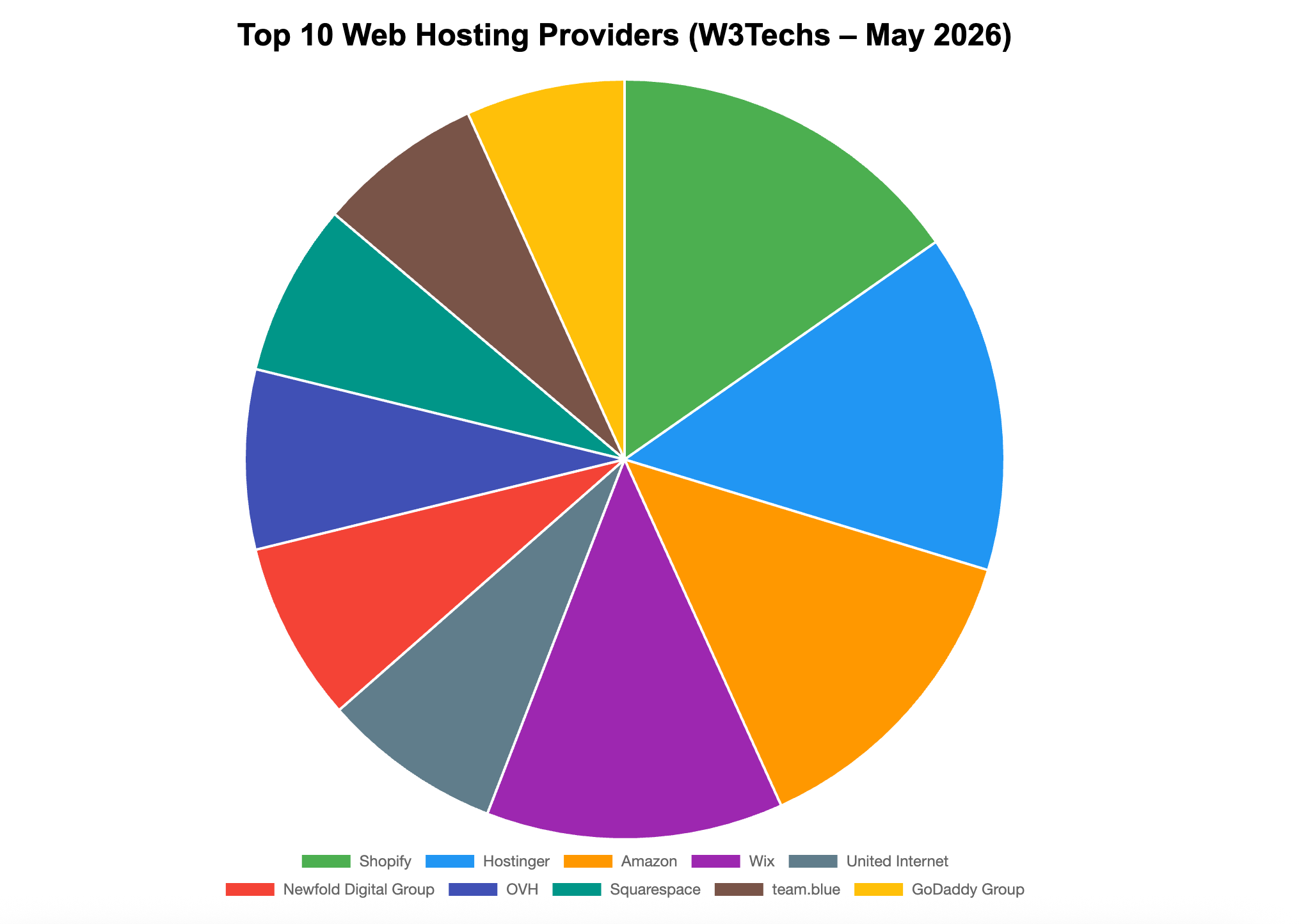
(Pie chart html file, source: W3Techs).
While Shopify has the largest share (5.2%), Hostinger and GoDaddy are two of the most popular choices for small and medium businesses as they offer low-cost shared hosting with one-click CMS installs. Hostinger hosts 4.9% of the total websites, while around 1.8% of all websites globally use GoDaddy for hosting.
When it comes to CMS platforms, WordPress still clearly dominates the web, powering around 42.5% of all websites. Shopify follows at 5.2%, while Wix holds about 4.3%. (W3Techs)
Looking at domain extensions, .com remains the most popular domain extension globally, holding roughly 40%+ of all domain registrations. Newer extensions, such as .ai, .io, .app, and .shop, are growing quickly, especially among startups and tech companies (TechRadar).
In terms of languages, nearly 49.6% of all websites are in English, making it the dominant web language. (Siteefy)
How Many Websites Are Mobile-Friendly?
Mobile optimization is no longer a differentiator; it's the minimum standard. In the top 1 million sites, 4 in 5 websites are designed to be mobile-friendly (DemandSage). The expectation is no longer whether a site works on mobile, but how well it performs there.
The reason is simple: 52.27 of all global web traffic now comes from mobile devices ( Statista). And 84% of users prefer browsing on mobile devices (Network Solutions).
Google’s Mobile-First Indexing policy is another solid reason to optimize sites for mobile devices. If your site loads slowly, renders poorly, or breaks on a small screen, your rankings suffer regardless of how well-optimized your desktop version might be.
Conclusion
Hundreds of thousands of new sites are added to the web every single day. Thanks to AI tools, building a website has become simple and affordable. Anyone can build a professional website with a single prompt without any coding skills. If you’re wondering how many websites are there on the internet, this article answers all your questions.
Sign up for Readdy to create your own website in minutes and join the millions of active websites on the web!
Frank Zhu
Frank is the founder of Readdy.ai. A developer-turned-founder with 10+ years of product experience, Frank loves great design, and he's building the tools he wishes he had when launching his first startup.