How to Build a B2B Website in One Day with AI and Readdy
Learn the AI website building workflow used to create an enterprise landing page in one day using ChatGPT, Claude, and Readdy — including prompting, production briefs, reference sites, and review loops.

Frank Zhu
Frank is the founder of Readdy.ai. A developer-turned-founder with 10+ years of product experience, Frank loves great design, and he's building the tools he wishes he had when launching his first startup.
One founder. No engineers. No agency. A full enterprise landing page — built solo with Readdy, now driving 100+ active deals.
Here's the framework.
Start Where You Already Work
Most founders, PMs, and operators already spend half their day inside ChatGPT or Claude.
Drafting positioning. Iterating on pitch lines. Asking the LLM to read a competitor's site and point out what's wrong. Pasting in customer feedback, looking for patterns.
By the time it's time to build a website, the LLM you've been working with already knows your business.
It knows your audience, your tone, your differentiators, your most recent strategic shift.
That's a huge asset most people throw away.
When the moment comes to build, most people switch tabs to an AI website builder and start describing their business from memory. They mention what their product does, who it's for, maybe a tone they like.
It's not a bad start. But it's a fraction of what they could bring.
The work they did with the LLM all morning — the customer pain points they finally articulated, the positioning that landed, the references they collected — most of that stays behind in the other tab.
The shift is simple: don't leave that context behind.
Take what your LLM already knows, ask it to write a production brief, and bring that brief into Readdy as the starting point.
That's the loop the founder used:
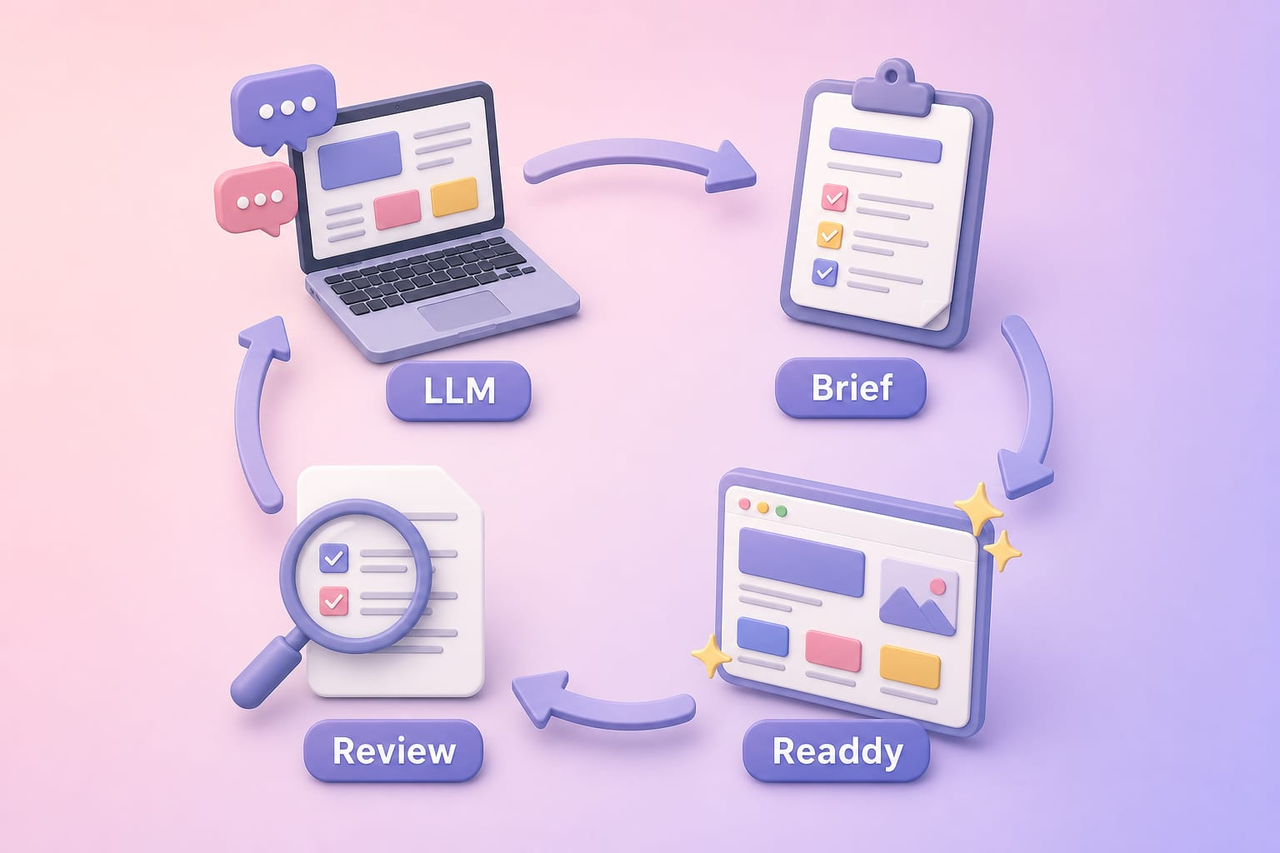
In his own words:
"The best place to start is to get your brief from whatever LLM you work with, and then pass that brief to Readdy."
The review step is the one most people skip. It's also the one that compounds quality the fastest.
"Don't be scared to go to ChatGPT or Claude and say 'what do you think of this website? What needs to improve?' Then take that information and give it back. It's like getting an extra set of eyes."
The mental model that makes this click:
"It's like having a team of scriptwriters, of image producers, of mathematicians. I've spent hundreds of hours training ChatGPT to understand our business. So when I go to Readdy, I bring that team with me."
Most people walk into the builder alone.
Power users walk in with a team.
Why Preparation Is Everything
If you only remember one thing from this piece, remember this:
A one-week build and a one-day build use the same AI. What separates them happens before the AI gets involved.
The founder framed it through a metaphor that stuck:
"Before you turn on the stove, you chop the garlic, dice the onions, prepare the thyme. Everything is ready in little bowls. Then it comes time to cook. In it goes. Quick. Easy. Trying to cook the risotto at the same time when you're chopping is a total mess."
"Preparation unlocks the enjoyment and the quality of what you build."
Building a website with AI works the same way.
If prep happens during the build, every interruption breaks the loop. You stop to look up the pitch deck mid-prompt. You try to remember which competitor's hero section was worth borrowing. You draft the value proposition on the fly.
That fragmentation has a hidden cost. And it's enormous.
On Day 1, the founder showed up to Readdy with materials in hand. Not vibes:
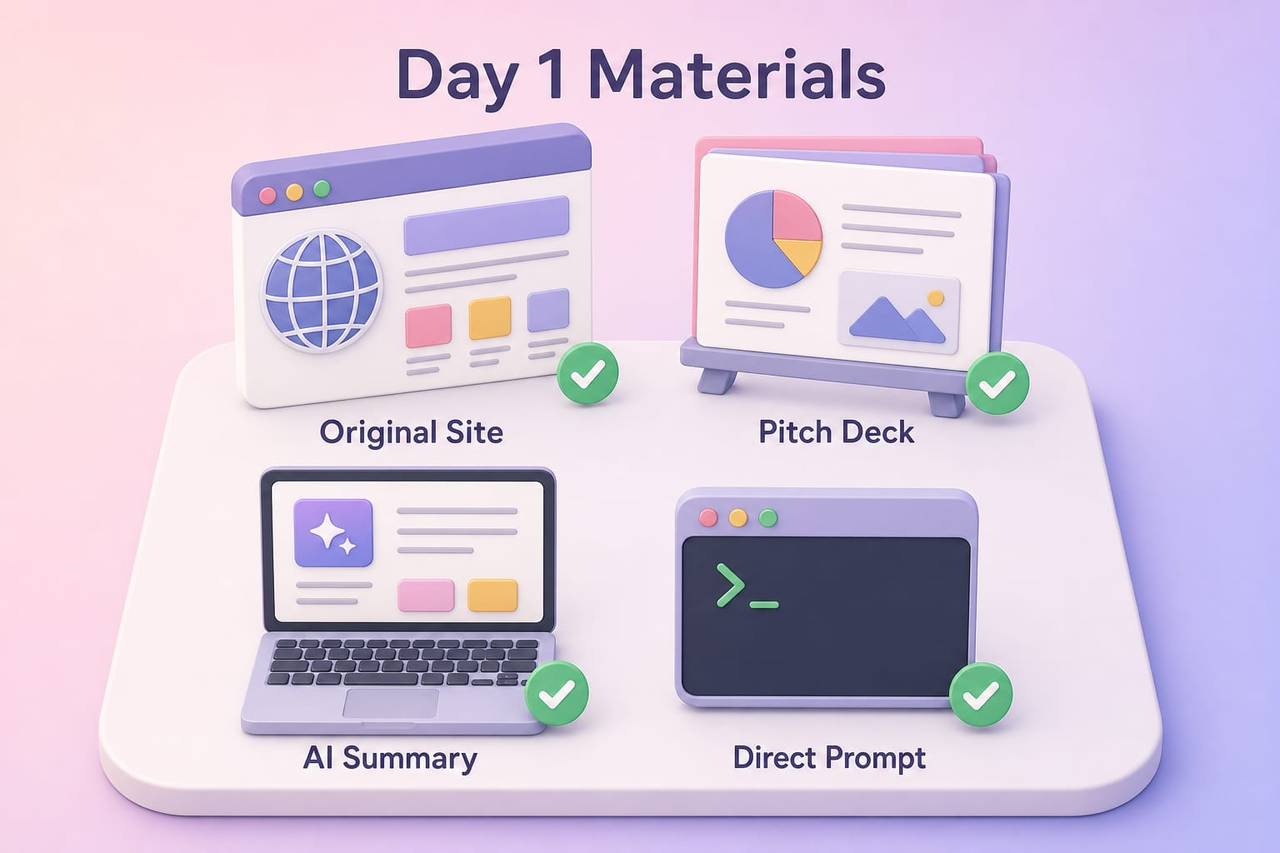
- The original consumer site, used as a structural template
- All slides from the pitch deck
- A ChatGPT-generated summary on how to approach enterprise customers
- A direct prompt: "Go create me something that sells our API to enterprises."
"70 to 80 percent of the time, it comes down to understanding the interface and understanding how to explain things."
The lesson hidden in that number:
The output traces back to one thing. How clearly the work was prepared in the first place.
Three things to have ready before opening Readdy
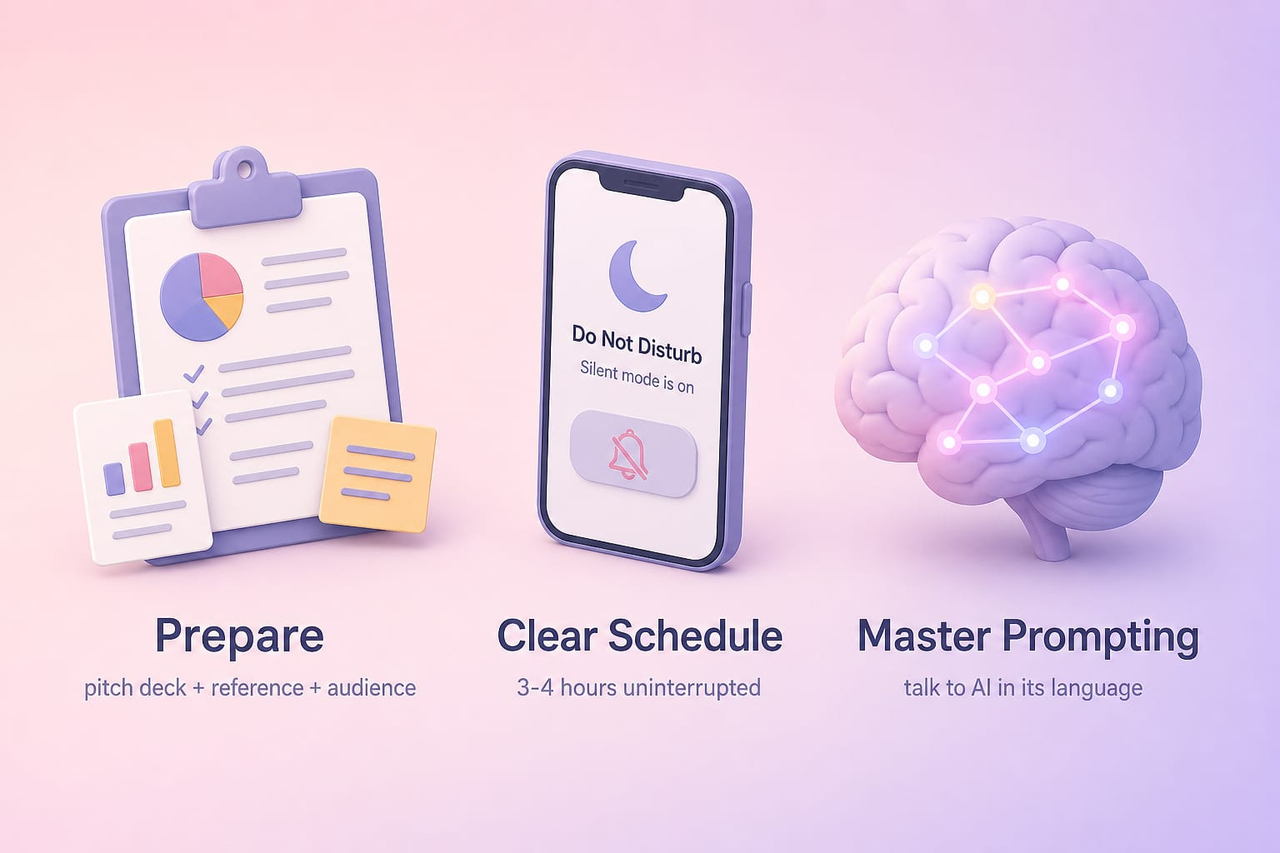
1."Make sure you're prepared." The pitch deck. A reference site to use as a template. A clear definition of who the page is for, and what problem it solves for them.
"If you don't know who your customer is — who's going to be reading it — you're never going to produce these websites."
2."Clear your schedule." 3-4 hours of uninterrupted time. Slack on DND. No "quick syncs."
"Everybody, I'm not available. Because if you keep getting interrupted every five minutes, you're never going to produce anything of serious quality."
Space and preparation, together. One without the other doesn't work.
3."Understand the science." The science here is prompting. Readdy itself is easy to learn. The harder skill is knowing how to talk to it.
That's the next section.
How to Talk to Readdy Like It's Listening
Most prompting advice tells you to "be specific." That's not wrong. But it misses something deeper:
The language of human aesthetic intuition doesn't translate cleanly into the language a machine understands.
When someone says "make it feel more premium," they know exactly what that means. The machine has to guess.
Two habits turn this around.
Be Specific
The most common mistake with AI builders: asking for vibes instead of changes.
❌ "Make it look more modern."
❌ "Make the hero pop."
❌ "Tighten things up."
These are feelings. The machine has to guess what you mean.
What works better is specific direction. You don't need to write code. You just need to point at what and say where:
✅ "Make the headline larger and move it to the left."
✅ "Use a darker background for this section."
✅ "Place the image on the right of the text, not below it."
✅ "Add more space between the cards."
But specificity has a ceiling. Sometimes what you want is a feeling — more modern, more sophisticated, cleaner — and you have no idea what specific change would get you there. You can't say "move it 20 pixels" because you don't know that 20 pixels is the answer.
That's when references do more than words ever could.
Use a 'Universal Translator'
There's a moment every builder hits: you see a website, an animation, a color palette, a layout — and you want it. Or some version of it. But when you try to type it into Readdy, nothing comes out right. The words don't match the feeling.
This is what the founder calls the universal translator problem. You don't know how to speak prompt. ChatGPT and Claude do.
The method is the same in every case: take what inspired you, hand it to an LLM, ask it to write the prompt, paste the prompt into Readdy.
Three places this shows up most:
- Visuals, color, layout. Already have a reference image? Drop it into Readdy's Reference Image and the style gets applied directly.
- Animations and interactions. This is where most people get stuck. You can feel that you want something more dynamic or more alive — but those words don't translate. Describe the motion to an LLM in plain language — "a glow that follows the mouse with a slight lag, like a flashlight through colored glass" — and let it write the actual animation prompt, with the easing, transform, and performance details Readdy can execute on.
- Whole sites you admire. Don't ask how to copy them. Ask what they're doing right. Then describe that to Readdy. The animations will show up. The spacing will tighten. Not as a copy — as something that absorbed the same principles.
The shift, in one line: stop asking how to copy what you love. Start asking how to describe it.
The Playbook
The whole methodology in one place. Save this:
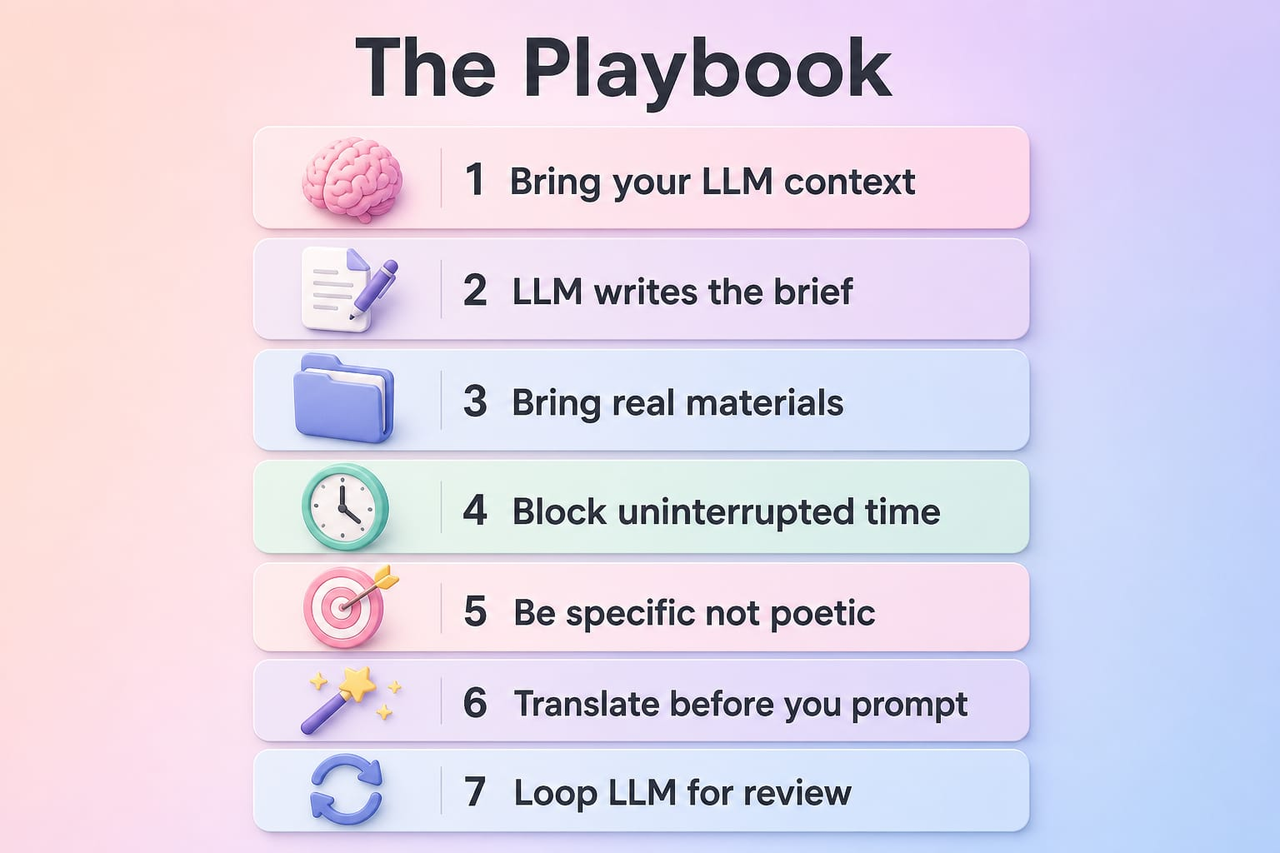
- Don't leave context behind. The LLM you already work with knows your business — bring that knowledge into Readdy with you.
- Have the LLM write your production brief. It's the bridge between your context and Readdy's execution.
- Bring real materials. Pitch deck, reference site, clear audience definition.
- Block uninterrupted time. Preparation and clear hours. Both are required.
- Be specific, not poetic. "Move it left, make it bigger" beats "make it pop."
- Translate before you prompt. When words don't come, hand the reference to an LLM and let it write the prompt for you — for visuals, drop a reference image into Readdy; for animations, describe the feeling and let the LLM convert it into the technical prompt.
- Loop the LLM back in for review. Two sets of eyes, every iteration.
The promise of AI website builders has always been "anyone can ship a great site fast."
What most people miss: the speed depends just as much on how well you prepare as on the tool itself.
The founder shipped his site in a day because both halves were in place — a clear brief, a clear hour, a team of LLMs in his back pocket, and a builder that could actually execute on what he handed it.
The tools are getting better. The teams that figure out both halves first are the ones that ship.
Ship yours in a day. → Readdy.ai
Frank Zhu
Frank is the founder of Readdy.ai. A developer-turned-founder with 10+ years of product experience, Frank loves great design, and he's building the tools he wishes he had when launching his first startup.