


How an Entertainment Veteran Used AI to Build the Platform Independent Artists Deserve
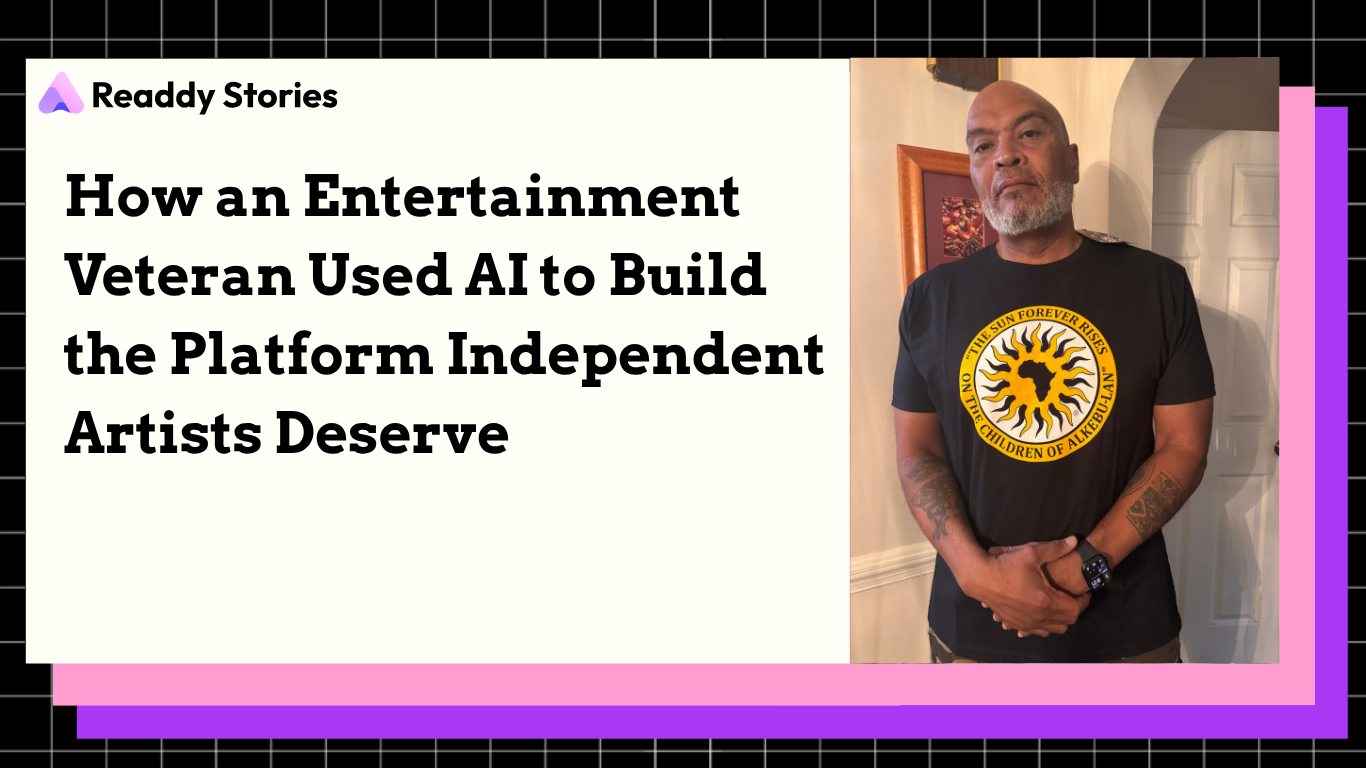
After 26 years in entertainment and technology, A-Sun finally found the right tool. He used Readdy to build Break Free, a platform that lets independent artists connect directly with their fans and keep 95% of their revenue.
Frank is the founder of Readdy.ai. A developer-turned-founder with 10+ years of product experience, Frank loves great design, and he's building the tools he wishes he had when launching his first startup.
AI is often seen as a threat to artists. But what happens when someone uses it to fight for them instead?
The Problem That Wouldn't Let Go
A-Sun has spent 26 years solving problems. Across movies, television, radio, and technology, that's been the through line. Someone brings him something broken, and he figures out how to fix it. He's worked with music artists, producers, and managers. He's done tech checks with members of Wu-Tang Clan. He's built a network that spans Grammy winners and up-and-coming independents alike.
But one problem kept coming back. No matter how talented the artists, no matter how many fans they had, the math never added up. An artist could hit 100,000 streams on Spotify and walk away with $500. That's it. For a hundred thousand people listening to your work.
"That doesn't make any sense to me," A-Sun says. The way he sees it, the platforms that distribute music aren't the ones creating it, yet they capture most of the value. The people who actually write, sing, and perform walk away with almost nothing.
This wasn't a new frustration. He traces it back to the very beginning of the recording industry. The first song ever recorded, he points out, was by an African American artist who never received any money from it. From that moment to the present, the pattern hasn't changed. Artists create. Corporations extract. Fans never get close enough.
"Music is like food and water to me," he says. "I love music. I love art. And I need these things."
Years of Searching
A-Sun had been trying to find ways to help artists survive for years. But the entrepreneurial playbook always looked the same: have an idea, recruit people to work on sweat equity, chase investors, wait six months, a year, sometimes two years before anything comes to life.
He knew what he wanted to build. He had the business plan, the market research, the white papers, the executive reports. Everything was in his head and on paper. What he didn't have was a way to build it himself.
Starting around September of the previous year, he began experimenting with AI website building tools. He tried several well-known platforms, spending nearly $2,000 across them.
None of them worked the way he needed.
"They're not that memorable, honestly," he says. "I wasted a lot of money."
The First Prompt That Worked
Then he stumbled on Readdy.
A-Sun's process is meticulous. Before he touches any tool, he consolidates everything: business plan, one-sheet, marketing materials, presentation deck. He hashes out the idea until it's solid and locked in. Then he uses AI to generate a detailed prompt, refines it through multiple iterations between himself and the model, and only then feeds the final version into a builder.
The first time he put that prompt into Readdy, he sat staring at his screen.
"I was looking at my computer like, what? Where have you been all this time?" he says. "I needed this for years. I've been needing a tool like this."
He called his wife over. "Sweetheart, come and look at this."
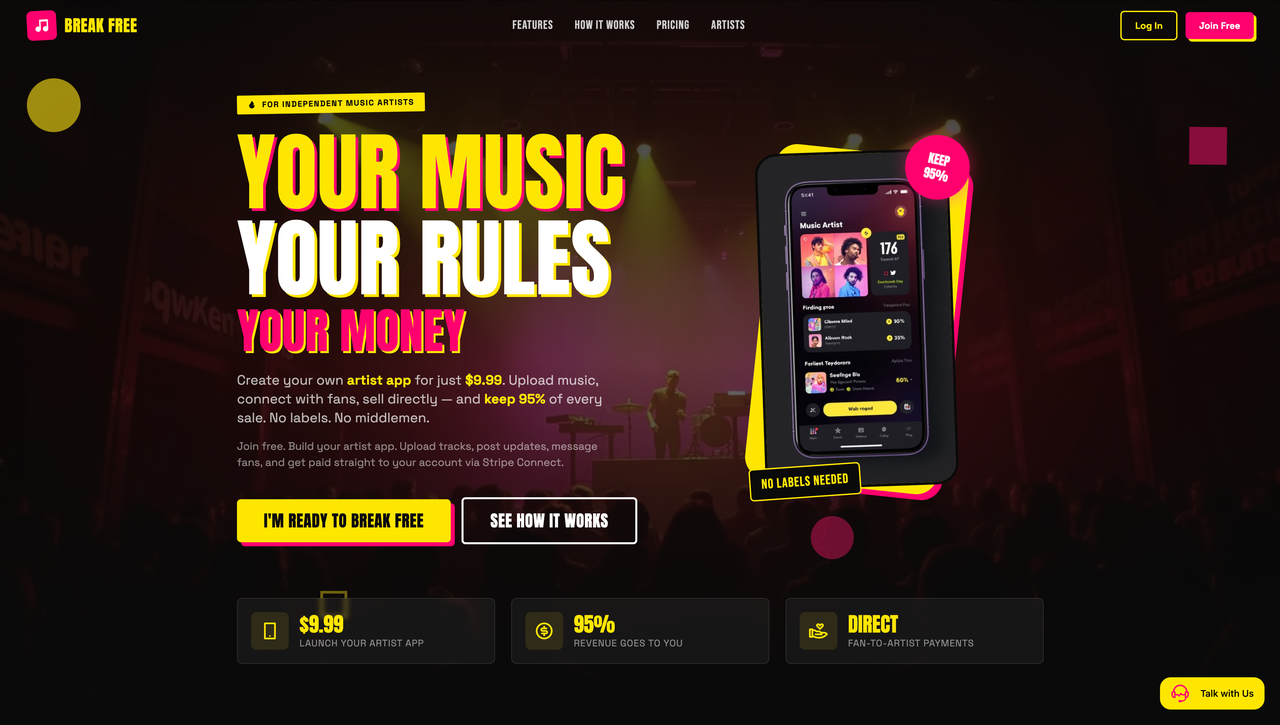
The entire Break Free website took roughly four edits. Not four days, not four weeks. Four rounds of refinement. He uploaded a few graphic design references, images by a young designer from India whose 3D font style and color combinations inspired him, and told Readdy to redesign the interface with that aesthetic as inspiration, not to copy it. The result was a site that looked nothing like the cookie-cutter outputs he'd seen from other platforms.
"Most AI-built websites end up looking the same," he says. "But with Readdy, I found a way to make it unique."
What Break Free Actually Does
The platform A-Sun built is called Break Free. The domain is breakfree.network, not .com. The name says it all.
Here's how it works. An artist creates an account, uploads their music, photos, videos, whatever they want to share. They get their own social-media-style chat environment where they can communicate directly with fans. They can offer content for free, sell it as premium, or set up a subscription model where core fans get special perks for being in the inner circle.
The vision goes further. A-Sun is building toward a model where Break Free generates a mobile app for each artist. The artist uploads it to the App Store or Google Play and sets their own price. Fans download it and get everything. The full catalog, behind-the-scenes content, studio sessions, the artist cooking dinner, driving through the city with friends. It's the album and the artist, all in one place, with no middleman.
The cost to the artist? $9.95 for the service. If they use Break Free's payment processing through Stripe, the platform takes 5% per transaction. If they prefer their own payment system, they take the code and keep everything.
Artists keep 95% of their revenue.
"I don't need to be greedy," A-Sun says. "I want the artist to make money."
"Break Free Is Not the Star"
What's striking about A-Sun is where he positions himself in this story. Not at the center.
"Break Free is not the star," he says. "All we have is a server. All we have is a website. The artist should be in the spotlight."
His priority isn't mass marketing or major label partnerships. His focus is on independent artists, people working hard to make good music who want to engage with their fans without a corporation standing in between.
He tells every artist he meets the same thing: keep doing Spotify, keep doing Apple Music. But when you release a single, also release an app. Give your fans something they can't get on a streaming platform. Give them you. Because what fans really want isn't just the music. They want to know the person behind it.
"You are the product," he tells them. "They want to know you."
More Than Music
Break Free is currently in soft launch, with about 15 people testing the system. A-Sun recently recruited a CEO for the company, a young man based in Los Angeles, and the team is personalizing the platform before a wider rollout. New features are coming: merchandise sales, livestreaming, video and audio interaction tools.
But what excites A-Sun most isn't the feature list. It's what the tool has unlocked beyond his own project.
His sister-in-law is coming to visit, and he plans to show her how to build a website for her property management business. A friend in Wisconsin named Lord Master, a man who once physically intervened to save a woman from a violent assault, wants to build an app to raise awareness about domestic violence and connect women with resources to escape dangerous situations.
"This isn't just for music," A-Sun says. "I love the name Readdy because it means ready to help people who have good ideas."
Good Music and Bad Music
When you ask A-Sun what kind of music he likes, the answer is everything. Jazz, hip hop, EDM, Chinese meditation music, Brazilian samba, rock, heavy metal, reggae, country. He quotes Duke Ellington: there are only two kinds of music, good and bad.
That's the philosophy behind everything he's building. The industry wants to compartmentalize music into neat little boxes. This is rock, this is hip hop, this is reggae. But the people who make and listen to music don't think that way. A rock fan loves reggae. A rapper listens to jazz. Music is music.
And the people who make it deserve to eat.
"These artists, they have to make a living," A-Sun says. "They have to eat. They have to have a place to live. They have families. And I want to help contribute to that."
Twenty-six years of solving problems in entertainment. Months of failed experiments with other tools. And then, one prompt, a moment so exciting he called his wife over to see the screen, and a platform that finally matched the vision he'd been carrying all along.
Break Free is live. The fight goes on.

Frank Zhu
Frank is the founder of Readdy.ai. A developer-turned-founder with 10+ years of product experience, Frank loves great design, and he's building the tools he wishes he had when launching his first startup.