What Is a White Label Website? The Complete Guide for Agencies and Freelancers
Learn what a white label website is, how it works, and how AI-powered builders like Readdy help agencies and freelancers deliver branded sites faster.

Kael
Kael is an editor and content strategist covering AI tools, website creation, and online growth. Interested in how people build and share on the internet, Kael writes practical content around digital products and modern web experiences.
A white-label website is a website built by one party, usually an agency or a freelancer, but delivered and presented under a different company's brand, with no visible trace of who actually built it or what tools were used. The agency or freelancer handles the technical work behind the scenes. If you're an agency, freelancer, or design studio building websites for clients, white-labeling lets your name stay on the invoices, communication, and project dashboard your client sees, while anyone who visits the finished site sees only the client's own name, logo, and identity.
Companies worldwide are increasingly using white-labeling services, including white-label website services, to save time, reduce costs, and avoid the hassle of developing the actual product. It’s no surprise that the global white-labeling market is currently valued at $28.3 billion and is expected to reach $75.0 billion by 2033.
In this guide, we’ll break down exactly what white label websites are, how they work, and the role of modern AI-powered website builders in building white label websites.
Quick Answer: A white label website is a website built by a third-party provider but delivered under another company’s name and branding. If you're a freelancer or agency creating a white-label website, you handle the actual website design and development, and your client gets to present it as their own. A white label website builder like Readdy lets you apply your own branding across the entire platform, not just the final site, so even the login screen, dashboard, and domain your clients see carry your name instead of the platform you use to build the site.
White-label website solutions have quickly become one of the most efficient ways for businesses to launch a website. Instead of hiring developers, companies rely on external services or platforms to deliver websites under their own brand.
What Is a White Label Website?
A white-label website is a site created by a third-party provider that sells it to another company, which then presents and promotes it to end users under its own name and branding.
Building a white-label website means you handle all the technical setup, such as design, development, debugging, and hosting. The client gets the final product (a complete website) that they can present under their own brand without ever touching the code or building a single website page themselves.
The key is the separation between who builds the site and who it appears to belong to. You do the technical work behind the scenes, but the client's customers only ever see the client's brand.
That said, the client's customers and your client see two different brands. When your client signs up for your service, logs in, or receives a notification from you, they see your branding, but once their site is live, anyone visiting the website sees only the client's brand.
White label website services aren't limited to building websites from scratch only. They can also cover ongoing maintenance, updates, and bug fixes. Basically, with white-label website services, businesses don’t always have to hire full-time employees. They can simply outsource the work.
But the ownership is still with the business owner. They manage customer expectations, handle all communication, and provide ongoing customer support. They also have full control over the pricing of their products or services. They decide how much to charge the customer, what packages to offer, and how to structure your service plans. The white label provider simply provides a complete website for their business.
Here’s how a white-label website differs from traditional website creation:
| Factor | Traditional Approach | White Label Website |
| Team | In-house developers | External provider |
| Cost | Fixed cost (high) | Variable, scalable |
| Speed | Slower | Faster delivery |
| Branding | Your brand | Your brand |
| Execution | Internal | Outsourced |
White Label Website vs White Label Website Builder: What's the Difference?
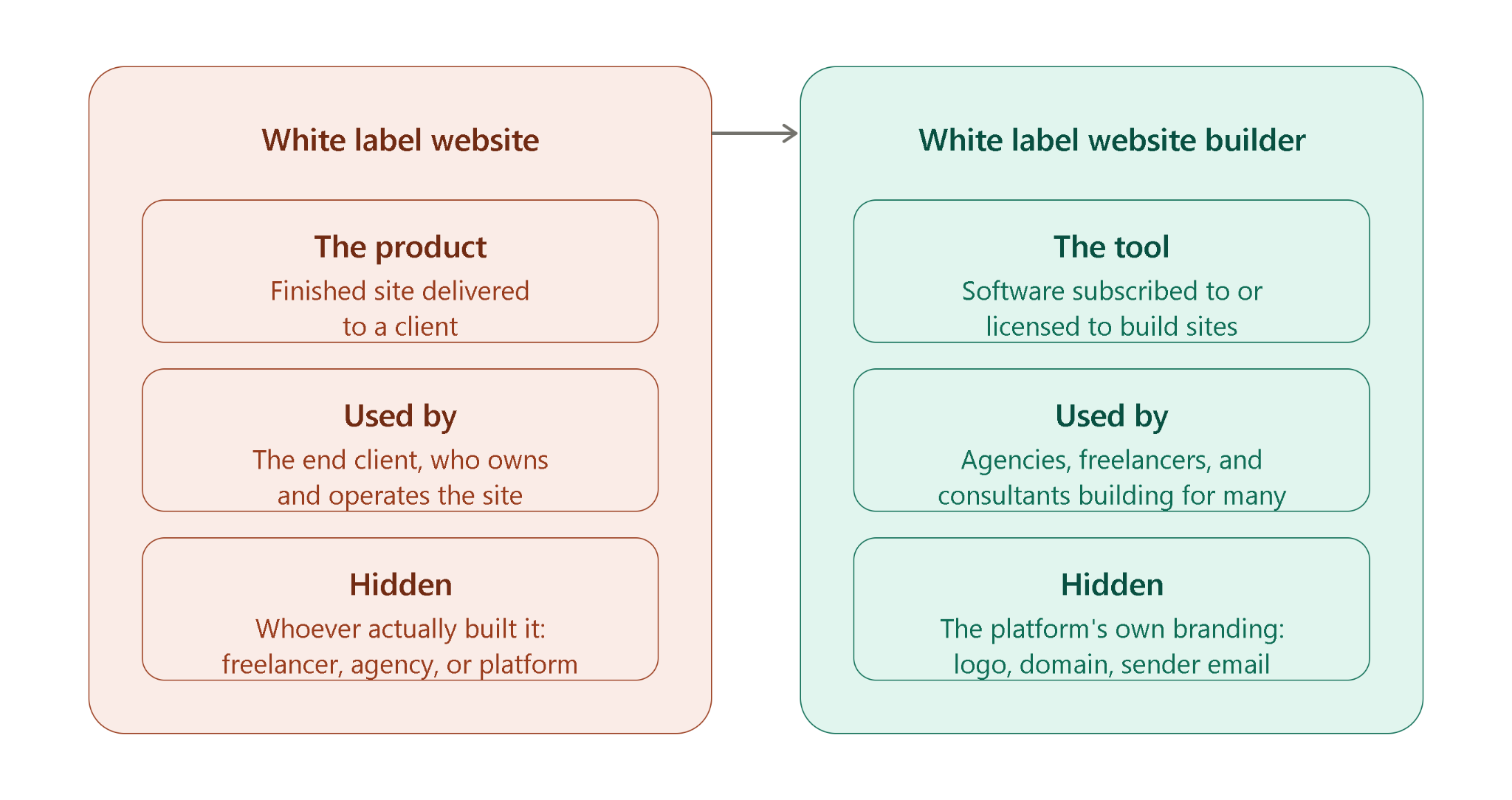
A white label website is the finished product: a fully built, functioning website that's sold or delivered to a client under their brand, not the company that built the website. The agency, freelancer, or consultant's name is what shows up on the invoice and the login screen. The tools, templates, or developers behind it stay invisible.
For example, a web design agency building a white-label site in WordPress or Webflow may use freelancers or templates to create the site, but the client they are building it for won’t know if they built it from scratch or what tools they used. What matters to them is that they get a fully functional and well-designed website.
A white label website builder is the software an agency uses to build that website, with the added ability to remove the platform's own branding so the client never sees it. Some traditional builders offer these features. For example, Webflow lets you bill clients directly and hide its own badge on published sites. But few offer the features to rebrand the entire experience, inclduing the login screen, the dashboard, and the domain clients see.
An AI-powered website builder like Readdy lets you build complete, custom sites through prompts, then apply your own branding across the whole experience, not just the published site. You describe through prompts what the business for which you’re creating the website does and its target audience, and Readdy creates the complete website with multiple pages, proper layout, and images in a few minutes. You can then refine the website either through prompts or a user-friendly visual editor.
Once you set up Readdy's White Label feature custom branding, including your own login domain, your own site domain, and a custom sender email, all applies automatically to every site you build. You don’t have to white-label each website individually.
The image below shows a quick comparison between a white label website and a white label website builder:
White label website services can include white label website development, white label web design, or both. White label website development usually means a technical build layer, which includes CMS setup, custom code, and integrations. White label web design means the design layer specifically, which includes wireframes, layouts, and visual identity.
How Does a White Label Website Work?
Here’s how it works:
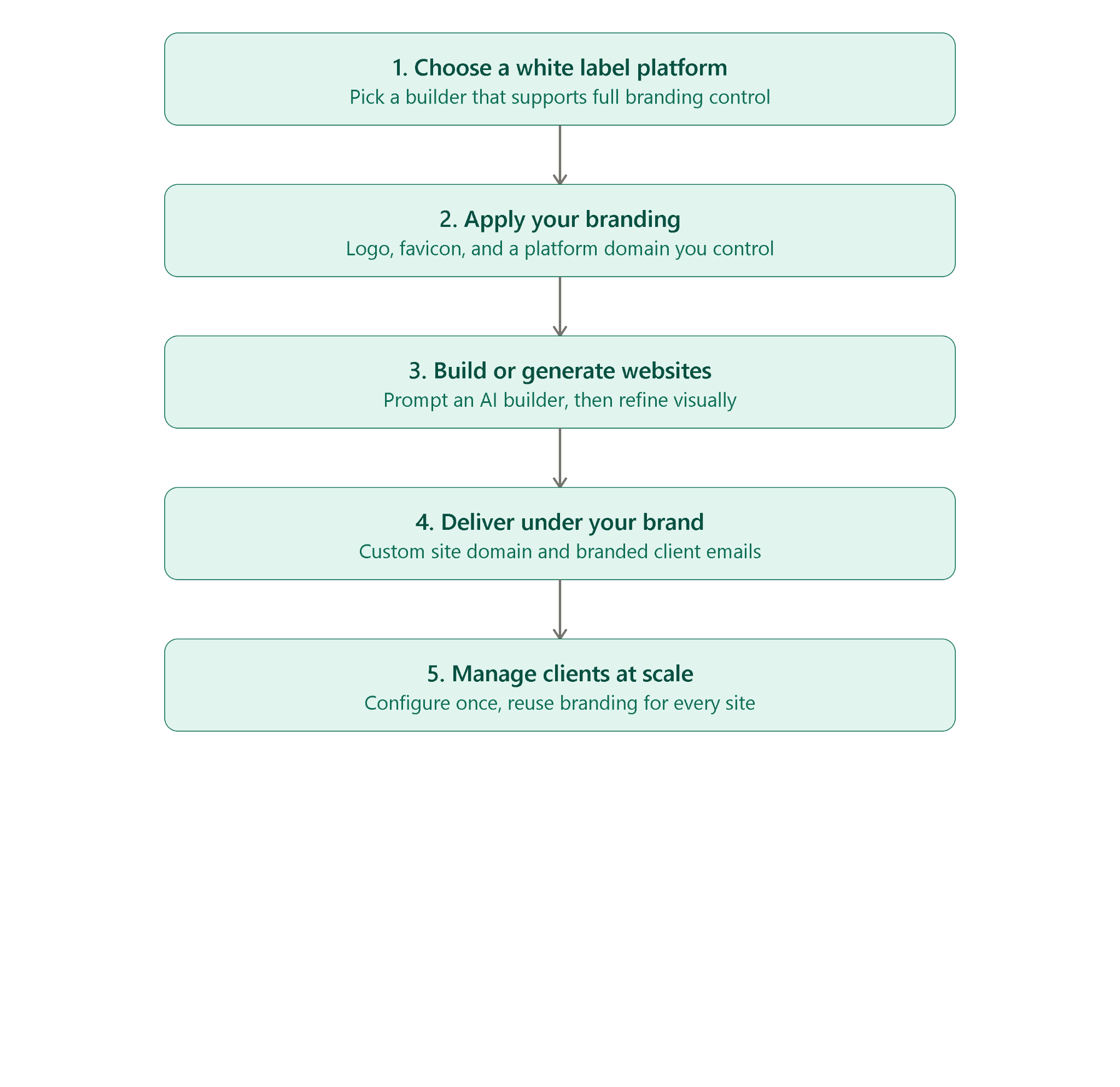
Step 1 — Choose a White Label Platform
Before anything else, you need a platform that actually supports white labeling. Look for a website builder that lets you customize branding, connect your own login and site domains, and send client communications from your own email address.
If you're planning to build white-label websites for multiple clients, using an AI website builder that supports white-labeling features is a great option. For example, Readdy is the only AI website builder that lets you apply your own branding across the whole experience, including your own login domain, your own site domain, and a custom sender email.
Before you start setup, you'll also want a few things ready: access to the DNS provider for any domains you plan to use, a platform subdomain (like app.youragency.com), and a verified sending domain if you want branded emails.
Step 2 — Apply Your Branding
Once you've picked a platform, the next step is to apply custom branding, such as your brand name, logo, favicon, and the title shown in the browser tab. These show up on the login page and throughout the editor, so this is the first thing both you and your clients will see.
From there, you connect your platform domain, which is the URL clients use to log in and access their dashboard. Instead of signing in through a platform-branded address, they'll use a subdomain you control, such as “app.youragency.com”. Setting this up means adding a CNAME record through your DNS provider and verifying it.
Step 3 — Build or Generate Websites
With your own branding in place, you can start building the actual websites. AI website builders like Readdy make this super quick and easy. Instead of starting from a blank canvas, you describe the client's business and target audience in plain language, and the platform generates a complete website with multiple pages, layout, images, and content in a few minutes.
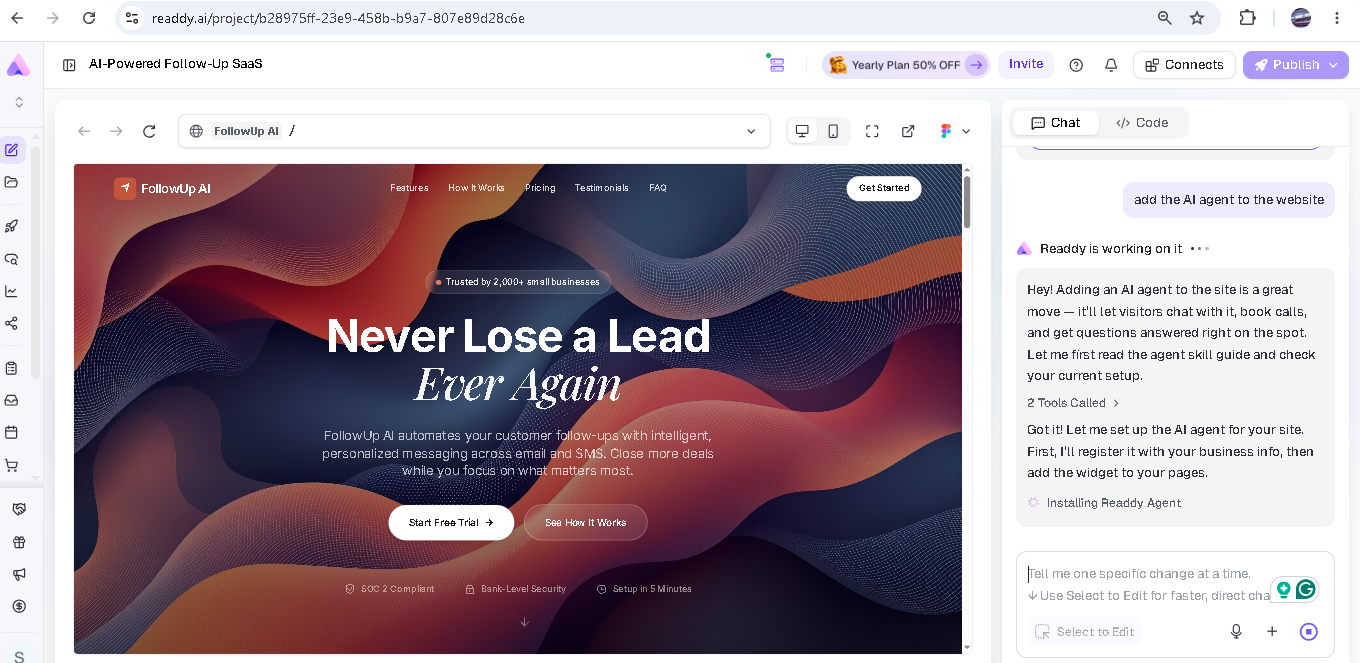
From there, you refine it. If you want to change the color scheme, rewrite a section, or add a new page, you can easily do that through more prompts or switch to a visual editor. And it all happens inside an account that already has your custom branding.
Step 4 — Deliver Under Your Brand
Building the site is only half the job. Delivering it with your branding without revealing the platform behind it is also important. This is what you use a site domain for. Instead of publishing under the platform's default domain pattern, your client's site goes live under a subdomain you control.
It’s also important to add a custom email so any automated message a client receives, such as an invitation to log in or a new lead notification, gets sent from your own sender address and brand name instead of the platform's.
Once you’ve set up everything, the client sees your branding on sign-up without ever seeing the name of the tool you used to build it.
Step 5 — Manage Clients at Scale
The real value of a white label setup shows up once you're handling more than one client. Readdy is the best tool to manage clients at scale. It lets you build professional websites quickly through prompts, so you can create multiple websites easily. And rather than repeating branding and domain setup for every project, you configure it once at the account level, then reuse it for any site you build with Readdy.
Why Businesses Use White Label Website Development
Businesses turn to white label website development because it lets them create websites without the need to hire a full in-house team to build them. Here are the key benefits of white label website development:
Faster Delivery
Building a website in-house means finding and hiring developers and designers and explaining to them the project scope. This process can take weeks before real work even begins. A white label provider or platform skips straight to production because they already have tested workflows in place and provide complete functional websites quickly.
With AI-powered white label platforms, things speed up even more. Instead of designing and building websites in weeks, a complete website with multiple pages, layout, images, and copy can be generated from a prompt in minutes, and then refined from there. For an agency juggling multiple client deadlines, a tool like Readdy is genuinely valuable.
Reduced Costs
White-label development helps businesses save a lot of time and money since they don’t need to build everything from scratch. Instead, they can use ready-made tools and present them under their own brand.
Recurring Revenue
A website isn't a one-time project. Clients come back for updates, maintenance, bug fixes, and redesigns. Instead of a single invoice, white label development can be based on retainer-style pricing: a monthly fee for hosting, updates, and support.
Scalability
With white label development, the core system is already built, and workflows are automated. So you can onboard more clients without hiring more developers and deliver websites faster.
Service Expansion
White labeling also lets a business offer services even if it has no internal expertise to deliver them. For example, you can easily create complete mobile-optimized websites with a white label AI website builder like Readdy without having any technical skills.
Who Should Use a White Label Website Builder?
A white label website builder is a strong choice for anyone who delivers websites to clients without wanting to run a development team. That includes freelancers working solo, marketing agencies offering web design services, design studios, as well as development agencies looking to speed up repeatable work.
Freelancers
One of the biggest challenges for freelancers is delivering high-quality work on time. Freelancers offering web development services can greatly benefit from a white label website builder, especially AI-powered website builders. These website builders let them create complete websites with attractive design within a few minutes through prompts. They can then refine the website to meet the client’s requirements.
Freelancers who are not proficient in website development can also use an AI website builder like Readdy to offer web development services. For example, a copywriter can offer a whole package of building the website and creating compelling content for it.
Marketing Agencies
Marketing agencies use white label website builders to offer web design as part of marketing services like SEO, ads, and content. Instead of hiring a third-party developer every time a client needs a new site or landing page, they can use an AI website builder like Readdy to create the site with their own branding. This saves agencies the cost of hiring external developers.
Building it in-house through a white label tool keeps both the revenue and the credit with the agency.
Design Studios
Design studios are usually strong on visuals and weaker on technical execution. A design studio can create great Figma files, but they need a developer to actually turn them into a working site. A white label website builder helps them turn their Figma designs into a fully functional website under their brand name.
The studio's design work provides a direction, and the builder handles layout, responsiveness, and all the technical aspects.
Web Development Agencies
Even agencies with developers on their team can use an AI white label builder to create websites quickly under their own brand. Not every project needs custom code. A standard business site or a landing page doesn't always require a developer. AI builder can generate the same result in minutes. That frees the technical team for the custom, higher-complexity work that actually needs them.
White Label Website Builder vs Custom Website Development
If you're choosing between a white label website builder and custom website development, you should consider the following factors:
Cost
For custom website development, you either need an in-house development team or external developers, which increases both project costs and operational overhead. Hiring a full in-house team means you need to pay salaries, benefits, and overhead to designers and developers, whether or not there's enough client work to keep everyone busy that month. Using a white label website builder replaces that fixed cost with a variable one.
With a white label website builder, you're looking at predictable, subscription-based costs. Most platforms charge a monthly or annual subscription fee or on a per-project basis. You're still the one delivering the finished website to your client under your own brand, but you don’t need a full-fledged team for it; you can use a platform like Readdy to create professional-looking websites quickly.
In most cases, agencies can deliver websites at a significantly lower upfront cost using a white-label website builder compared to custom development.
Speed
Speed is often the deciding factor for agencies, especially when they are handling multiple clients.
Custom website development typically takes months. Planning, design, development, testing, and deployment all take time. On top of that, complexity adds weeks or months. If your timeline is measured in weeks rather than months, custom development can be challenging.
White label website builders dramatically reduce delivery time because you’re not starting from zero. With AI-powered builders like Readdy, you can launch websites in a matter of weeks or even days.
Maintenance
With custom website development, maintenance is your responsibility. Server updates, security patches, dependency management, and bug fixes fall on you or a team you hire. A poorly maintained custom site can cost you clients and a lot of money. This ongoing cost is often underestimated in initial project planning.
When you’re using a white label website builder, technical maintenance is mostly handled for you. The platform manages updates, security patches, server maintenance, and backups. Your role is managing content and configurations. This is one of the key reasons many agencies prefer using a white-label AI website builder.
Flexibility
With custom website development, you can build almost anything, such as custom functionality, proprietary integrations, and unique workflows. This flexibility is what justifies the cost and complexity for many organizations.
When you’re using a white label website builder, you're constrained by the platform's feature set. If the builder doesn't offer a specific functionality, you can't build it without workarounds or leaving the platform. Customization exists, but within boundaries. For most use cases (e-commerce, landing pages, portfolios), this limitation rarely matters, but for highly specific requirements, it does.
Scalability
With an in-house team, you can take on a limited number of projects. At some point, taking on more clients will mean hiring another developer, which takes time to find and onboard. And hiring more developers means more costs.
Using a white label website builder like Readdy removes this limitation. You can use it to create as many white label websites as you want by simply adding extra sites individually for a small per-site fee or upgrading to a subscription plan that supports more websites.
This matters most for agencies that keep getting new clients quickly and don’t have enough time to hire teams for them.
Ownership
With custom website development, you own everything, including the code, the infrastructure, and the data. You're not dependent on any vendor. If you need to migrate or modify your site, you can do that.
On the other hand, with a white label website builder, you don't own the underlying platform. You own your content and configurations, but if the platform changes pricing, shuts down, or deletes your account, you lose everything.
Essential Features to Look for in a White Label Website Builder
When evaluating a white label website builder, here are the key features to consider:
Complete Brand Customization
Clients shouldn't see the builder's branding anywhere: not in the editor, not in the footer, not in client communications. Complete brand customization means you can white-label the entire platform, including your logo in every interface, your domain for client access, and even custom email domains for automated messages.
When clients log in and see your branding consistently, they perceive the platform as yours, not as a third-party tool. It strengthens client relationships and justifies your service premium. Some platforms offer basic customization. Look for ones that let you customize everything.
Custom Domains
Clients expect their site to live on their own domain, not on a subdomain of your platform. A robust white label builder should let you connect unlimited custom domains, handle SSL certificates automatically, and manage DNS efficiently. AI website builders like Readdy offer these features, making things easier for you and your clients.
Client Portal
The client portal is where your clients manage their sites. This should be clean, intuitive, and accessible. A good client portal lets them update content, view analytics, request changes, and understand what they're paying for without needing you to handle every small update.
The portal should reflect your branding entirely. When clients log in, they should feel like they're using your product, not a generic builder. Some platforms offer basic portals, but the best ones, like Readdy, let you customize the portal's layout, features, and messaging so it feels like a part of your service.
Team Management
If you have multiple people on your team, team management features are essential. You should be able to assign different permission levels (editors, viewers, admins) across multiple team members and client sites, and restrict what each team member can access and modify.
Look for platforms that let you define custom roles and permissions, not just "admin" and "editor."
Website Hosting
Who hosts the site matters a lot. Some builders offer built-in hosting, while others let you host anywhere. When the platform hosts your site, it handles uptime, performance, backups, and security patches. You don’t have to manage infrastructure. If hosting is separate, you're coordinating between multiple vendors, which adds complexity.
SEO Controls
SEO and search visibility are important for every client. Choose a website builder that offers essential SEO controls, such as:
- Customizable page titles
- Meta descriptions
- URL slugs
- Open Graph tags
- XML sitemaps
- Basic guidance on SEO fundamentals like alt text for images, heading structure, and readability.
The best platforms offer these features so you can quickly optimize your website for search visibility. For example, Readdy AI website builder includes built-in SEO essentials like:
- Meta titles and descriptions
- SEO indexing controls
- Auto-generated sitemap.xml and robots.txt
- Google Search Console verification support
- One-click SEO setup during publishing
AI Website Generation
Modern platforms like Readdy offer AI-powered site generation, allowing you to create complete websites from text prompts. These website builders help create professional websites for multiple clients quickly, even if you don’t have any technical skills.
White-Labeled Publishing
When clients publish sites, they shouldn't see the builder’s name or branding in the output. This includes DNS records, SSL certificates, infrastructure pages, and email confirmations. Everything should be under your branding.
Some builders offer complete white-label publishing, while others sometimes leave their branding embedded in some places.
Modern Example: How Agencies Scale with AI-Powered White Label Platforms
Suppose an agency takes on a new client needing a live website within a week. Instead of starting from a blank canvas, they prompt an AI website builder with the client's business details, brand assets, and a few reference sites. Within minutes, the builder provides a complete multi-page site with proper layout, structure, copy, and design.
The agency then refines it through prompts or a visual editor, connects the client's custom domain, and publishes under their own brand. The client never sees the underlying platform. This allows agencies to create various white-label websites for different clients quickly.
This is the workflow modern white label platforms are built around. Readdy's white-label ecosystem, for example, combines AI site generation with white-labelling features agencies actually need, so they can manage every client site from one place. Readdy's white-label features include custom branding, custom platform or site domains, custom email templates, and branded client login, built specifically for agencies delivering websites under their own brand.
Readdy offers dedicated subscription plans for agencies that require white label features. For example, Readdy's Agency Pro plan offers complete white-label features with a custom site domain, custom branding UI, custom email templates, and a branded client login screen.
Frequently Asked Questions
What is a white label website?
A white label website is a website created by a third-party provider but sold and presented under the brand name of a different company.
What is a white label website builder?
It's a platform that lets agencies and freelancers build, host, and manage client websites under their own brand. It allows them to rebrand the tool's interface, domain, and client-facing touchpoints as their own.
Is white label web design profitable?
Yes, it lets agencies scale faster by reducing development time and costs, so profit increases as you take on more clients without proportionally increasing workload.
Can clients see the original platform?
No, if a website is properly white-labeled, including custom domains and branded logins, clients don’t see the original platform. They only ever see your business name.
Are white label websites good for SEO?
Yes, white label websites are good for SEO if they have a custom domain, clean code, and proper SEO controls in place. SEO performance depends on the site's technical setup, not on which tool is used to build it.
Can AI website builders be white-labeled?
Yes, modern AI website builders like Readdy combine AI site generation with white-label features like custom branding, domains, and client portals, letting agencies deliver AI-built sites under their own name.
Final Verdict
A white label website builder is the right choice for most freelancers, agencies, and design studios that need to deliver professional websites quickly without carrying the cost, time, and overhead of an in-house development team. Custom website development still has its place when a project demands high flexibility, customization, deep integrations, or full ownership of the code and infrastructure, but for most business sites, landing pages, and e-commerce sites, that level of complexity is rarely needed.
AI-powered white label website builders like Readdy have made things even quicker and easier. With Readdy, you can create a complete website in minutes through prompts. It also offers white-label features for agencies, allowing them to automatically apply their own custom branding to the login page, the dashboard URL, and even the emails clients receive.
Want to deliver white label websites to multiple clients quickly? Sign up for Readdy to get started!
Kael
Kael is an editor and content strategist covering AI tools, website creation, and online growth. Interested in how people build and share on the internet, Kael writes practical content around digital products and modern web experiences.