What Is a .com Domain? A Beginner's Guide (2026)
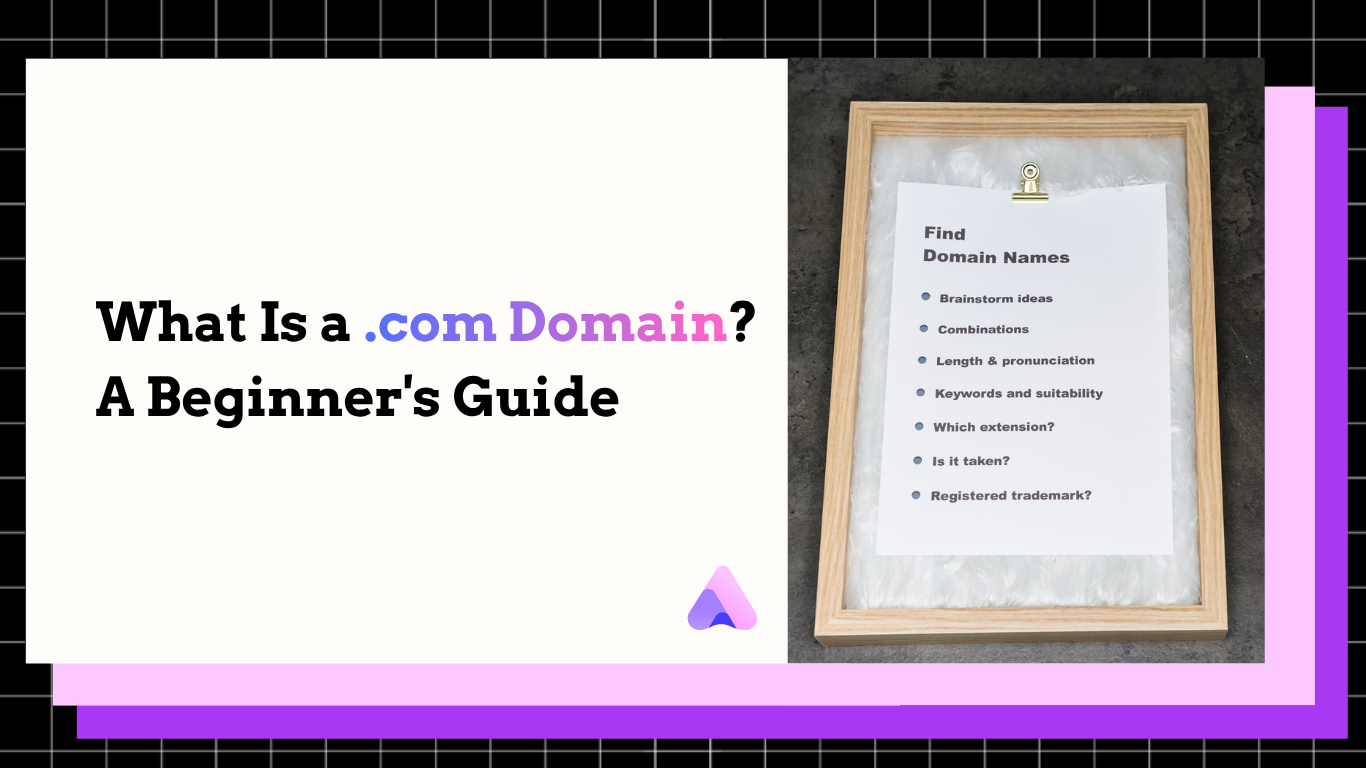
Learn what .com means, why it holds 157M registrations, and how it compares to .io, .ai, and country domains. Includes step-by-step registration guide and 2026 pricing.

Frank Zhu
Frank is the founder of Readdy.ai. A developer-turned-founder with 10+ years of product experience, Frank loves great design, and he's building the tools he wishes he had when launching his first startup.
Last Updated: June 2026
A .com domain is the world's most recognised website address extension, representing "commercial." Created in 1985, it holds over 157 million registrations — roughly 42% of all domains globally. This guide explains what .com means, why it dominates, how it compares to alternatives, and how to choose the right domain for your project.
Quick Answer
If you need a fast decision, here is the ranking of domain extensions by use case:
| Use Case | Best Extension | Why | Typical Cost |
|---|---|---|---|
| General business / global reach | .com | Highest recognition, lowest confusion risk | £10–20/year |
| Tech startup / SaaS / developer tool | .io | Shorthand for "input/output", strong tech signal | £30–50/year |
| AI / ML product or service | .ai | Direct relevance to AI sector, fast-growing trust | £80–100/year |
| Non-profit / community / open source | .org | Charitable and community associations persist | £10–15/year |
| Local business (UK) | .co.uk | Strong local credibility, potential local SEO lift | £5–15/year |
| Personal brand / portfolio | .me | Human-readable, personalisation signal | £10–20/year |
This guide evaluates domain extensions across five criteria:
- Recognition — measured by user recall and brand association;
- Credibility — perceived legitimacy among general and technical audiences;
- Availability — ease of finding an unregistered name;
- Cost — standard first-year and renewal pricing;
- Audience fit — alignment with specific sector expectations.
Data sources include Verisign registry reports (2025), ICANN registration statistics, and published UX research on domain memorability.
The .com extension, first registered in 1985, remains the only TLD with over 157 million active registrations — nearly ten times larger than any alternative — making it the default mental model for internet addresses across all demographics.
What Does ".com" Mean?
The ".com" extension stands for "commercial." It was created in January 1985 as one of the original seven top-level domains, alongside .edu, .gov, .mil, .net, .org, and .int. The very first .com domain, symbolics.com, was registered on 15 March 1985 by Symbolics Inc., a Massachusetts-based computer manufacturer.
Originally intended for commercial organisations, the categorisation broke down by the mid-1990s as the web became public. Today, .com is operated by Verisign and functions as a global extension with no restrictions on registration. Despite the "commercial" label, personal blogs, portfolios, and non-profits routinely use .com without restriction.
Why Is .com So Popular?
1. First-Mover Advantage
The internet's commercial infrastructure was built on .com. Major websites from the dot-com era — Amazon (1994), eBay (1995), Google (1997) — established it as the standard. By the time alternatives proliferated after 2000, .com had already cemented itself as the default.
2. Memorability
Research indicates .com domains are roughly 33% more memorable than other extensions. Users automatically append .com when hearing brand names. This cognitive shortcut reduces marketing friction and word-of-mouth loss.
3. Credibility Signal
Many people associate .com with established, legitimate businesses. While it will not make an untrustworthy site trustworthy, lesser-known extensions can create momentary doubt. A 2023 consumer trust survey found .com scored 14% higher on perceived legitimacy than .net and 22% higher than .io among general audiences.
4. Network Effects
With 157 million domains registered, .com is nearly ten times larger than any other extension. This concentration perpetuates its default status: the more people use it, the more others expect it.
In 2025, .com domains remain 33% more memorable than alternatives and score 14–22% higher on perceived legitimacy — a structural advantage that compounds through network effects with every new registration.
.com vs Other Domain Extensions
Direct comparison across credibility, cost, availability, and best use case:
Extension: .com
Best For: General business, global reach
Typical Cost: £10–20/year
Credibility (General): Highest
Credibility (Tech): High
Availability: Very limited
Key Trade-off: Name scarcity; premium pricing for desirable names
Extension: .net
Best For: Tech, networking, SaaS
Typical Cost: £10–15/year
Credibility (General): High
Credibility (Tech): High
Availability: Moderate
Key Trade-off: Acceptable fallback when .com is taken
Extension: .org
Best For: Non-profits, communities
Typical Cost: £10–15/year
Credibility (General): High
Credibility (Tech): Moderate
Availability: Moderate
Key Trade-off: Charitable association; avoid if commercial
Extension: .io
Best For: Tech startups, developers
Typical Cost: £30–50/year
Credibility (General): Moderate
Credibility (Tech): High
Availability: Good
Key Trade-off: Less familiar to non-technical audiences; higher cost
Extension: .ai
Best For: AI companies, tech products
Typical Cost: £80–100/year
Credibility (General): Growing
Credibility (Tech): Very High
Availability: Good
Key Trade-off: Premium pricing; niche signal
Extension: .co
Best For: Startups, short brands
Typical Cost: £10–20/year
Credibility (General): Moderate
Credibility (Tech): Moderate
Availability: Good
Key Trade-off: Often mistaken for .com in verbal communication
Extension: .co.uk / .de / .fr
Best For: Local businesses
Typical Cost: £5–15/year
Credibility (General): High (locally)
Credibility (Tech): Moderate
Availability: Varies
Key Trade-off: Strong local SEO; may limit international perception
.com vs .net / .org
.net was originally for network infrastructure; .org for non-profits. Neither restriction is enforced today, but associations linger. .org suggests charitable status — using it for a commercial product can confuse users. .net is an acceptable alternative when .com is taken, particularly for infrastructure or SaaS products where the "network" connotation still fits.
.com vs .io / .ai
.io (British Indian Ocean Territory) has become shorthand for "input/output" in tech. A 2023 survey indicated 11% of startups used .io domains. .ai (Anguilla) has surged with the AI boom, growing from 50,000 registrations in 2018 to over 600,000 by early 2025. Trade-offs include higher costs (£30–100/year) and less familiarity with general audiences. For B2C products, .com reduces friction; for B2D (developer-facing) or AI-native tools, .io and .ai signal sector alignment.
.com vs Country Domains
Country-code domains (e.g., .co.uk, .de, .fr) offer strong local credibility and potential SEO benefits for local queries, but may limit international expansion. Some codes escaped geographic origins: .co (Colombia) for "company," .tv (Tuvalu) for media, .me (Montenegro) for personal sites. A business targeting Germany exclusively should consider .de; a business planning EU-wide expansion should default to .com.
For B2C businesses targeting general consumers, .com reduces cognitive friction by 33% compared to alternatives; for B2D or AI-native startups, .io and .ai deliver stronger sector signalling despite lower general-audience recognition.
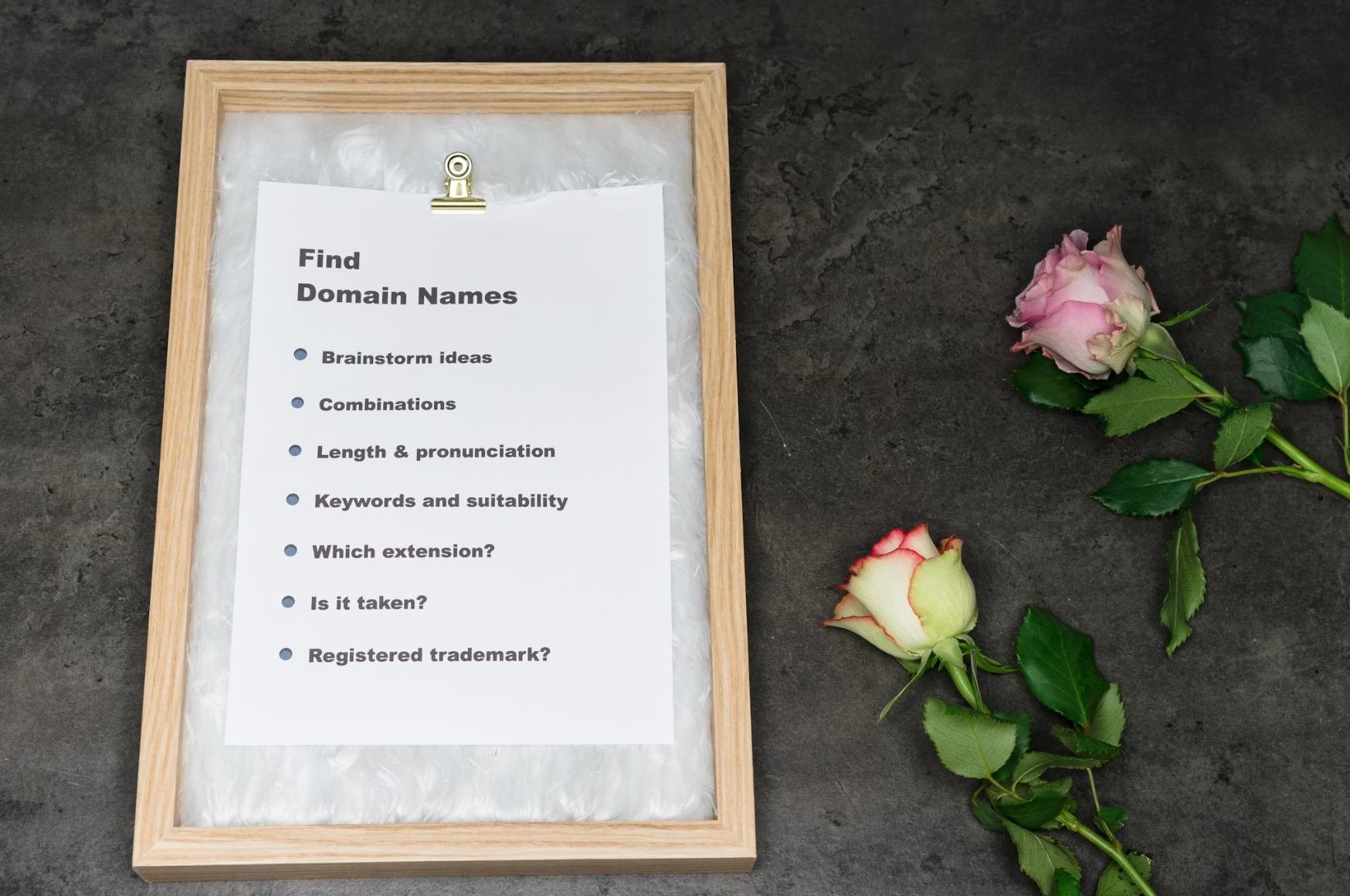
How to Choose the Right Domain for Your Business
Six competing priorities to balance:
- Keep it short: Aim for two words maximum; longer domains increase typos by 15–25% according to UX studies.
- Make it speakable: Avoid hyphens, numbers, and unusual spellings requiring explanation. Verbal shareability drives 20–30% of organic discovery for early-stage products.
- Match your brand: Should be your business name or obviously connected. Mismatched domains reduce direct traffic and trust.
- Check for conflicts: Search existing trademarks to avoid legal issues. A £10 domain is not worth a £10,000 trademark dispute.
- Consider your audience: .io or .ai works for tech-savvy users; .com or country codes suit broader or local audiences.
- Plan for scale: If you may expand internationally within 24 months, start with .com to avoid a painful rebrand.
What If the .com Domain You Want Is Already Taken?
Option 1: Natural Modifications
Add descriptive words that clarify your offering. Example: acmedesign.com instead of acme.com. This preserves brand recognition while improving clarity and often availability.
Option 2: Alternative Extensions
A clean .io or .co may serve better than a convoluted .com. Dropbox started on getdropbox.com before acquiring dropbox.com; Zoom used zoom.us before scaling globally. The extension matters less when the name is clean and the product is strong.
Option 3: Create a New Word
Invented names like Spotify, Skype, or Etsy sidestep availability issues entirely. This approach requires stronger marketing investment but eliminates domain competition.
Option 4: Acquire the Domain
Use WHOIS lookup to contact owners of parked domains. Expect prices from hundreds to tens of thousands of pounds depending on length, dictionary status, and existing traffic. Budget 5–15% of your initial branding spend for domain acquisition if the name is critical.
Avoid: Problematic Shortcuts
Hyphens and strange spellings create confusion. Users forget hyphens, mishear spellings, and arrive at competitor sites. Data shows hyphenated domains lose 18–25% of type-in traffic to the unhyphenated version.
Companies like Dropbox and Zoom proved that a clean alternative domain outperforms a convoluted .com: Dropbox operated successfully on getdropbox.com for four years before acquiring its exact-match domain.
How to Register a .com Domain (Step-by-Step)
Step 1: Choose a registrar.
Options include Namecheap, GoDaddy, Google Domains, Cloudflare, or all-in-one platforms like Readdy AI Website Builder that bundle registration with hosting and DNS management.
Step 2: Search for your domain and check availability.
Most registrars show alternatives if your first choice is taken. Use filters to hide premium-priced names unless your budget allows.
Step 3: Complete the purchase with accurate contact information.
ICANN requires verified contact details; privacy protection (WHOIS masking) is available from most registrars at no extra cost or included by default.
Step 4: Configure DNS settings to point to your hosting.
This involves setting A records (for direct server pointing) or CNAME records (for platform hosting). TTL (time-to-live) values of 300 seconds allow rapid propagation during setup.
Step 5: Connect to your website.
On integrated platforms like Readdy, this step is automated — the platform registers the domain, configures DNS, provisions SSL, and deploys your site in a single workflow.
Step 6: Verify SSL certificate installation.
Modern browsers flag HTTP sites as "Not Secure." Most registrars and hosting platforms provide free Let's Encrypt certificates; verify auto-renewal is enabled.
Step 7: Set up domain monitoring.
Enable auto-renewal to prevent expiration-related downtime. Expired domains enter a grace period (typically 30 days), then a redemption period (30 days), then public re-release where competitors or squatters may capture them.
Using AI Tools to Simplify Domain & Business Name Selection
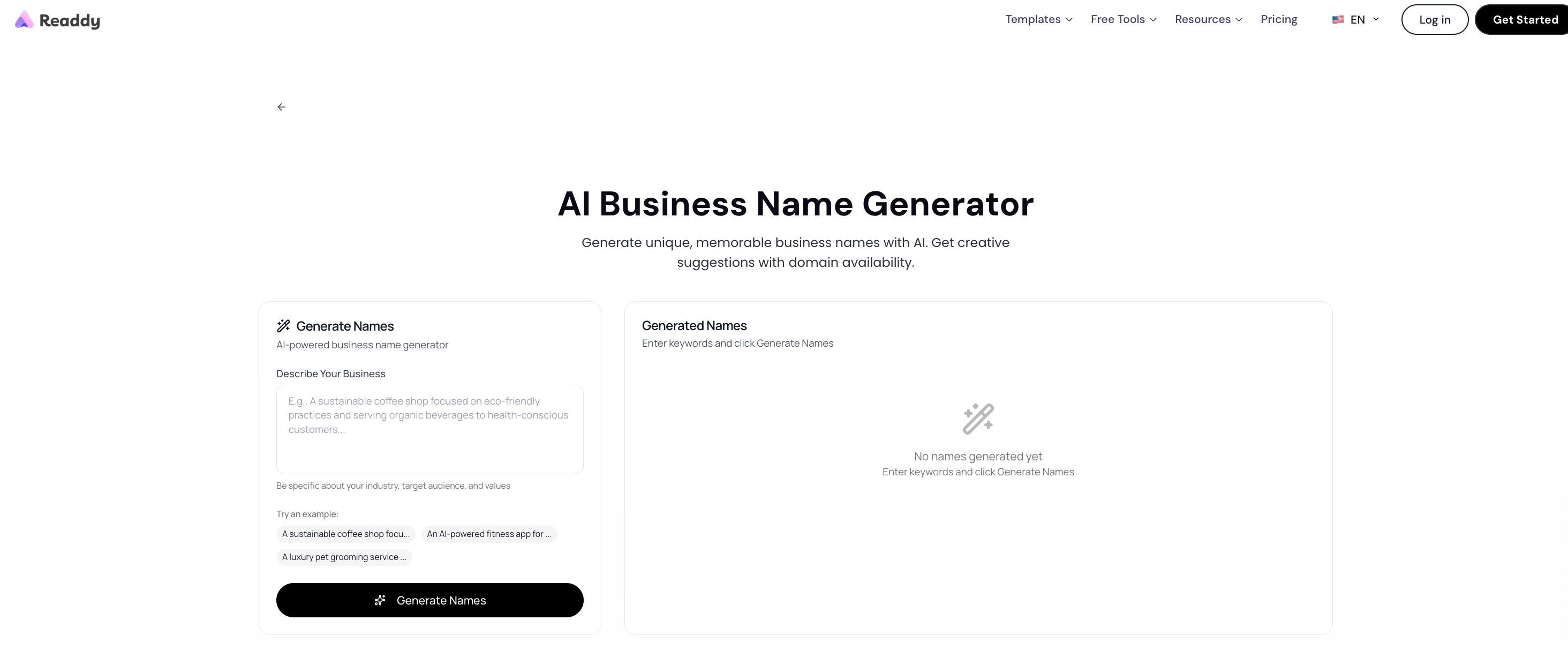
Modern AI tools compress the brainstorming cycle from weeks to hours. Readdy's AI Business Name Generator suggests creative names with instant domain availability checking across .com, .io, .ai, and country-code extensions. All-in-one platforms like Readdy integrate domain registration, DNS configuration, SSL certificates, and hosting, removing friction for beginners and reducing setup time from days to minutes.
Frequently Asked Questions
Q: Is a .com domain better for SEO?
No. Google confirms extensions do not directly affect rankings. However, .com domains may earn higher click-through rates due to user familiarity, indirectly benefiting SEO through improved engagement signals. A 2022 CTR study found .com results received 8–12% more clicks than equivalent .net or .org results in identical positions.
Q: How much does a .com domain cost?
Standard registrations cost £8–20 per year. Promotional first-year pricing may drop to £1–5, with full price on renewal. Premium domains — short, dictionary, or highly brandable names — can cost hundreds to thousands of pounds. Always check renewal pricing before purchasing; some registrars discount year one but charge £30+ on renewal.
Q: Can I use .com for a non-commercial website?
Yes. Despite standing for "commercial," there are no usage restrictions. Personal blogs, portfolios, open-source projects, and non-profits routinely use .com. The extension is functionally generic.
Q: What if my .com domain is already taken?
Try natural modifications (add descriptive words), explore clean alternatives like .io or .co, create a brandable invented name, or contact the owner if the domain is parked. Budget for acquisition if the exact name is strategically critical.
Q: How do I register a .com domain step-by-step?
Choose a registrar, search availability, complete purchase with verified contact details, configure DNS to point to hosting, connect your website, verify SSL installation, and enable auto-renewal. All-in-one platforms automate steps 4–6.
Q: Is .com still the best choice in 2026?
For general businesses targeting global or mixed audiences, yes — .com offers the highest recognition and lowest confusion risk. For tech startups, AI products, or local-only businesses, .io, .ai, or country codes may be better fits.
Q: Does domain length affect performance?
Domain length does not affect SEO ranking. However, longer domains increase typo rates and reduce memorability. Aim for 15 characters or fewer for optimal recall. Data shows 2-word domains are recalled correctly 40% more often than 3+ word alternatives.
Q: Should I buy multiple extensions to protect my brand?
For established brands, yes. Secure .com, your country code, and .net at minimum. For startups with limited budget, prioritise .com and add others as revenue allows. Defensive registration reduces cybersquatting and phishing risks.
Q: What is the difference between a registrar and a registry?
The registry (Verisign for .com) maintains the master database of all domains under that extension. A registrar (GoDaddy, Namecheap, Cloudflare) sells registrations to the public and interfaces with the registry on your behalf. You cannot buy directly from the registry; you must use an accredited registrar.
Q: How long does DNS propagation take?
DNS changes typically propagate within minutes to 48 hours, depending on TTL settings and regional resolver caching. Using a modern registrar with fast TTL defaults (300 seconds) and global anycast DNS reduces propagation to under 30 minutes in most cases.
Q: Are premium domains worth the cost?
Premium domains are worth the cost when they deliver measurable business value: type-in traffic, brand credibility, or elimination of marketing spend to educate users on an obscure name. A short, memorable .com can reduce customer acquisition costs by improving direct traffic and word-of-mouth referrals.
Final Verdict
Use this decision framework to select the right extension:
Choose .com if...
You target a general audience, plan international expansion, want maximum memorability, or need the highest default credibility. Ideal for e-commerce, services, content sites, and established businesses.
Choose .io if...
You are a tech startup, developer tool, or SaaS company targeting technical buyers who understand the "input/output" connotation. Accept the moderate general-audience friction as a trade-off for sector alignment.
Choose .ai if...
You build AI/ML products, chatbots, or automation tools where the extension itself reinforces your value proposition. Worth the premium pricing (£80–100/year) when your entire brand narrative centres on artificial intelligence.
Choose .org if...
You operate a non-profit, community, or open-source project where charitable associations strengthen trust. Avoid for commercial products — the mismatch confuses users and reduces conversion.
Choose a country code if...
You serve a single country exclusively and local SEO or trust signals outweigh international ambition. Plan to add .com if you expand beyond that market.
In 2026, .com remains the single safest default for global businesses, while .ai and .io have carved out legitimate niches for sector-specific startups — the right choice depends on audience alignment, not extension prestige alone.
Frank Zhu
Frank is the founder of Readdy.ai. A developer-turned-founder with 10+ years of product experience, Frank loves great design, and he's building the tools he wishes he had when launching his first startup.