







What Is a Blog? The Only Definition You Need in 2026
A blog is a website section with regularly updated posts in reverse chronological order. Learn the history, types, and how to start one in 2026—with real data. Includes platform comparison (WordPress, Readdy, and more).
Frank is the founder of Readdy.ai. A developer-turned-founder with 10+ years of product experience, Frank loves great design, and he's building the tools he wishes he had when launching his first startup.
Last updated: June 2026
A blog is a website—or a section of a website—where content is published regularly in reverse chronological order. The newest posts appear first, and older ones get pushed down the timeline. That simple structure, born in 1994 as a personal online diary, now powers over 600 million active websites worldwide and generates roughly 7.5 million new posts every single day.
Businesses with active blogs see 55% more website visitors on average and 434% more indexed pages in Google. So yes, the format still matters—arguably more than ever.
This guide breaks down what a blog actually is, how it works, why it still beats social media as a long-term asset, and how to start one that lasts.
Quick Answer: Blog vs. Website vs. Social Media
If you want the short version, here is how blogs stack up against other content formats in 2026:
| Feature | Blog | Static Website | Social Media | Newsletter |
|---|---|---|---|---|
| Update frequency | Regular, ongoing | Rarely | Constant stream | Weekly or monthly |
| Content order | Reverse chronological | Fixed structure | Algorithm-driven | Sequential delivery |
| Ownership | Full domain control | Full domain control | Platform-controlled | You own the list |
| Content lifespan | Years (evergreen) | Indefinite | Hours to days | Single open |
| Google visibility | High | Moderate | Minimal | None |
| Audience growth | Slow but compounding | Static | Fast but volatile | Moderate, stable |
| Upfront cost | Low | Medium | Zero | Low |
| Best for | Long-term asset building | Brochure/validation | Distribution and discovery | Relationship depth |
A blog is the only format that gives you full ownership, high search visibility, and compounding traffic over years. Social media is what marketers call "borrowed land"—great for reach, but one algorithm change can wipe out your audience overnight.
Where Blogs Actually Came From

The first blog was not called a blog. In 1994, a Swarthmore College student named Justin Hall started publishing personal writings online. It was a simple collection of links and thoughts, but it set the pattern: dated entries, newest first, informal tone.
In 1997, Jorn Barger coined the word "weblog" to describe a site that logged interesting web discoveries. Two years later, Peter Merholz jokingly split the word into "we blog" on his sidebar, and the term stuck. By 1999, Blogger launched and made publishing accessible to anyone without coding skills.
WordPress arrived in 2003. That changed everything. Suddenly you could run a publication-sized site without touching HTML. The Huffington Post and TechCrunch launched the same year, proving blogs could challenge established media. By 2010, businesses realized that answering customer questions through blog posts was cheaper and more effective than advertising. By 2020, over 70% of B2B companies had active blogs.
Today, roughly 80% of creators use AI tools to help with drafting, research, or formatting. But the core format has not changed: a stream of dated, updated content organized around a specific voice or topic.
How a Blog Actually Works (The Technical Side)
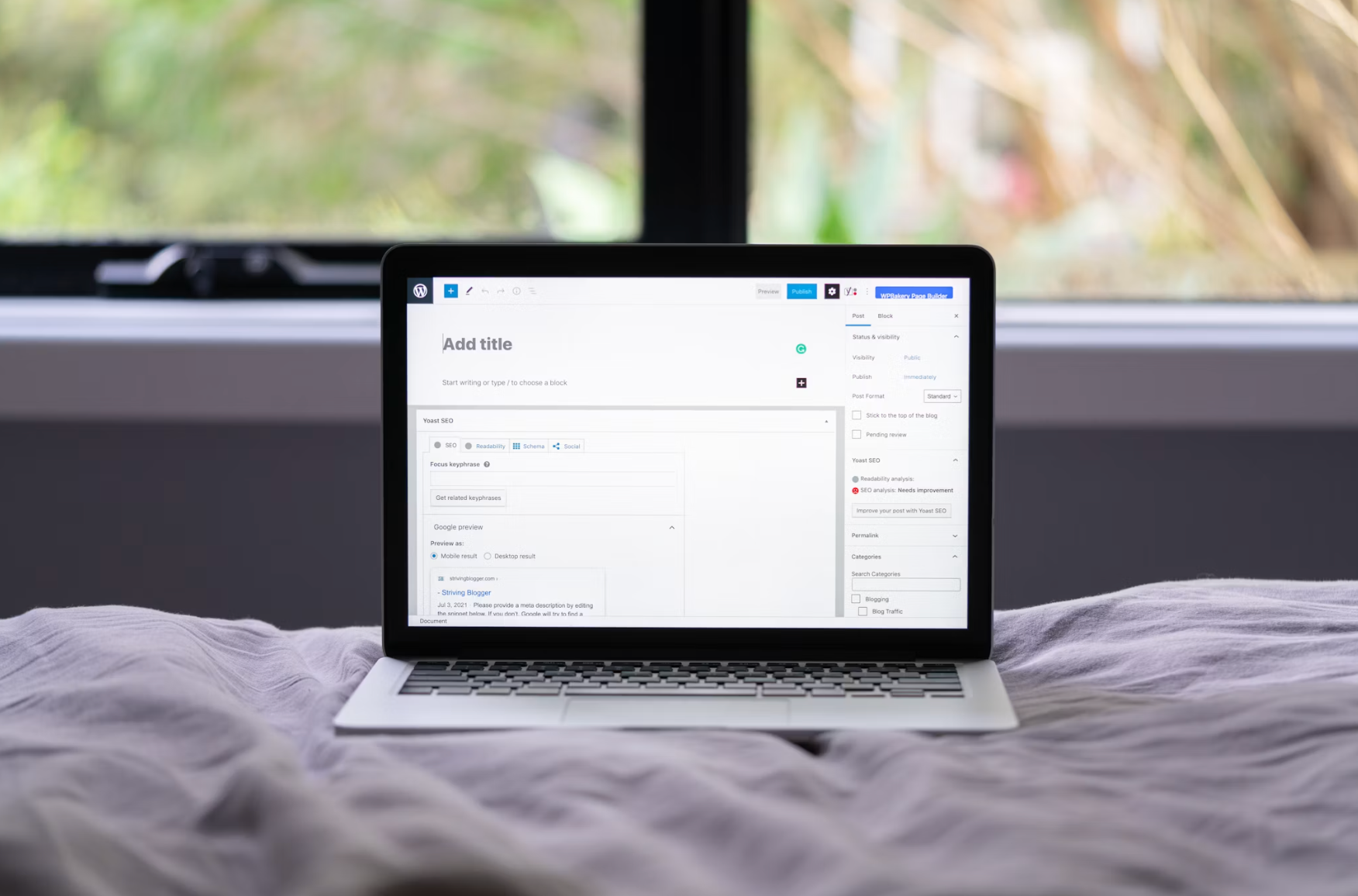
You do not need to know how to code. A content management system (CMS) handles the structure for you.
WordPress still dominates with a 43% market share of all websites on the internet. But it is not the only option. Wix and Squarespace work well for beginners who want drag-and-drop simplicity. Ghost is a stripped-down alternative for writers who hate bloat. Substack combines blog publishing with email delivery, which is why so many independent journalists migrated there in the last few years.
More recently, AI-powered website builders have entered the market. Tools like Readdy AI website builder let you generate a complete blog—including layout, navigation, and responsive design—from a simple text description or visual reference. This is useful if you want to skip theme selection and manual configuration entirely, though you will still need to write the actual content yourself.
What makes a blog post different from a regular page?
A blog post is dated, authored, and part of a series. It lives inside categories and tags. It has a commenting section (sometimes). It is designed to be discovered through search or RSS feeds, not just site navigation.
A static page—like an About or Contact page—has no date, no author byline, and no expectation of updates. Both live on the same site, but they serve different purposes.
The typical publishing workflow looks like this:
- Choose a topic based on what your audience is searching for
- Draft the content in your CMS or a writing tool
- Format with headers, images, and internal links
- Write a meta title and description for Google
- Assign categories and tags for organization
- Schedule or publish
- Distribute through social, email, or relevant communities
Most modern themes are mobile-responsive by default. The layout stacks vertically on phones: header, content, sidebar elements, footer. That is table stakes in 2026. If your blog theme is not mobile-friendly, switch it.
The Seven Types of Blogs That Actually Exist
Not all blogs are personal diaries. Here is the full landscape:
| Type | What it is | Who runs it | Typical revenue model |
|---|---|---|---|
| Personal | Lifestyle, travel, creative projects | Individual writers | Minimal; often hobby-driven |
| Professional | Expertise demonstration to attract clients | Consultants, freelancers, executives | Service sales, speaking, consulting |
| Business / Corporate | Company-owned content answering prospect questions | Marketing teams | Lead generation, brand trust |
| Niche / Affiliate | Deep focus on one topic; buyer intent content | Solo operators or small teams | Affiliate commissions, ads |
| News / Media | Digital publication covering events or industries | Editorial teams | Advertising, subscriptions |
| Review / Comparison | Product evaluations and buying guides | Affiliate marketers | Commission-based revenue |
| Educational | Tutorials, explainers, skill-building | Teachers, institutions, coaches | Courses, memberships, ads |
The most profitable type depends on your constraints. Personal blogs rarely make money. Niche and affiliate blogs can scale to six figures but require volume and patience. Business blogs have the highest ROI for companies because they feed directly into the sales funnel.
Why Blogs Still Matter in 2026 (The Data)
Here is what the numbers actually say:
- 600 million+ active blogs worldwide
- 7.5 million new posts published daily
- Companies with blogs get 55% more visitors than those without
- Companies with blogs have 434% more indexed pages in Google
- High-frequency bloggers (3+ posts per week) see 3.5x the traffic of low-frequency bloggers
- Dedicated practitioners report being 13x more likely to see positive ROI
Those are not vanity metrics. Indexed pages mean more opportunities to rank for long-tail keywords. More visitors mean more chances to convert. And the compounding effect is real: a blog post written in 2022 can still drive traffic in 2026 if it answers a persistent question.
Compare that to social media, where a post's lifespan is measured in hours. Or paid advertising, where traffic stops the moment you stop spending. Blogs are fixed-cost assets that keep returning value.
That said, the barrier to entry has gone up. In 2010, you could rank a 500-word post with basic keyword stuffing. In 2026, Google prioritizes original experience, depth, and genuine expertise—what they call E-E-A-T (Experience, Expertise, Authoritativeness, Trustworthiness). The posts that win now are the ones that actually teach something.
AI tools have flooded the internet with generic content. That does not make blogging obsolete. It makes original, experienced-driven content more valuable, because it is harder to fake.
What Businesses Actually Use Blogs For
If you are running a company and wondering whether a blog is worth the time, here is how it fits into operations:
Inbound Marketing
People search for solutions before they search for vendors. A blog post that answers "how to fix X" or "what is Y" puts you in front of prospects while they are still in problem-solving mode. That is vastly more effective than cold outreach.
Organic Traffic Development
Every blog post is a new doorway into your site. Publish 50 posts targeting specific questions, and you have 50 chances to rank. Publish 200, and the math gets interesting. High-frequency publishers consistently outperform low-frequency ones.
Funnel Mapping
Blog content can be mapped to the buyer journey:
- Awareness stage: Industry trends, "what is" explainers, problem identification
- Consideration stage: Comparison posts, methodology guides, "best tools for X"
- Decision stage: Case studies, pricing breakdowns, implementation tutorials
Authority Building
Consistent, knowledgeable publishing positions you as a credible voice. It is not about claiming expertise. It is about demonstrating it repeatedly until your audience assumes it.
Content Repurposing
One detailed blog post can fuel a week of social media content, a newsletter segment, a video script, or a podcast episode. The blog is the source asset. Everything else is distribution.
How to Start a Blog (A Practical Guide)
This is not abstract advice. These are the exact steps you would take this week.
Step 1: Pick a Topic and Narrow It Down
"Fitness" is too broad. "Strength training for women over 40" is a niche. "Strength training for women over 40 with knee issues" is a niche you can own. Use Google Trends or Ahrefs to confirm people are actually searching for it.
Step 2: Choose Your Platform
| Platform | Best for | Learning curve | Cost range |
|---|---|---|---|
| WordPress.org | Long-term control and SEO | Moderate | $5–$50/month |
| Wix / Squarespace | Beginners; drag-and-drop | Low | $15–$40/month |
| Ghost | Writers who want speed | Low | $9–$50/month |
| Substack | Blog + email in one tool | Very low | Free–$50/month |
| Readdy AI website builder | Fast launch from text/visual input | Very low | Starter tiers available |
If you are serious about SEO and plan to publish for years, go with WordPress. It is not the easiest, but it is the most flexible.
If you want a blog live in under an hour and do not want to configure hosting, themes, or plugins manually, Readdy AI website builder generates the full site structure—including responsive design, navigation, and basic SEO setup—from a simple description. You will still need to write your own posts, but the technical scaffolding is handled automatically. That is a legitimate shortcut for founders or marketers who need to ship fast and iterate later.
Step 3: Buy a Domain and Hosting
Get your domain from a reputable registrar (Namecheap, Cloudflare, or Google Domains). For hosting, budget options like Bluehost or SiteGround work for starters. For growing sites, Cloudways or Kinsta offer better performance. Expect to spend $5–$30 per month depending on traffic.
If you use an AI builder like Readdy, hosting is often bundled, so you only need the domain.
Step 4: Set Up the Essential Pages
Every blog needs:
- A homepage that shows recent posts or a featured guide
- An About page that explains who you are and why you are credible
- A Contact page
- A blog archive or category page
- A privacy policy (required for ads and analytics)
Step 5: Write Your First Post
Do not start with an introductory "welcome to my blog" post. No one searches for that. Start with a specific question your target audience is already asking. Aim for 1,500–2,500 words.
Include:
- A clear H1 and descriptive H2s
- Short paragraphs (2–3 sentences max on mobile)
- At least one image with alt text
- Internal links to other posts (if you have them) or your core pages
- A meta title under 60 characters and a meta description under 160 characters
Step 6: Submit to Google
Set up Google Search Console and submit your sitemap. This tells Google your site exists and invites it to crawl your content. Do this before you start promoting elsewhere.
Step 7: Create a Publishing Schedule
Consistency beats intensity. If you can only manage one high-quality post per week, do that. If you can manage three, do that. What kills blogs is irregularity—three posts one week, nothing for two months. Pick a schedule you can actually sustain for a year.
Step 8: Track and Adjust
After 30–60 days, check Google Search Console to see which queries are driving impressions. Double down on what is working. Update or improve posts that are not ranking. This is a long game, but the data tells you where to focus.
Frequently Asked Questions
What Is the Difference Between a Blog and a Blog Post?
A blog is the entire website or section. A blog post is a single entry within it—one article with a title, date, author, and body content. Think of the blog as the magazine and the post as an individual article inside it.
Is Blogging Still Profitable in 2026?
Yes, but not quickly. Most revenue models take 12–24 months of consistent publishing to become meaningful.
Common paths include:
- Display advertising (Google AdSense, Mediavine)
- Affiliate marketing
- Sponsored posts
- Digital products
- Paid consulting
The bloggers who make money treat it like a business, not a side hobby.
Is Blogging Dead Because of Social Media and AI?
No. Despite predictions of blogging's death since roughly 2007, there are more active blogs now than ever. Social media is great for discovery, but it does not replace owned content. AI makes writing faster, but it also makes generic content easier to produce—which raises the value of original, experience-based writing. The medium is not dying. The bar is rising.
Who Can Start a Blog?
Anyone with a topic they know well enough to write about consistently. Technical barriers are effectively gone. You do not need to code. AI website builders like Readdy can generate the structural layout for you, but you still need to write the content and commit to a schedule.
How Much Does It Cost to Start a Blog?
- Free: Blogger or WordPress.com subdomain (yourname.wordpress.com)
- Budget: $50–$100/year for a custom domain and basic hosting
- Professional: $200–$500/year for managed hosting, premium theme, and essential plugins
- Advanced: $1,000+/year for dedicated hosting, custom design, and advanced tools
Most beginners can start for under $100 in the first year. If you use an AI builder with bundled hosting, your first-year cost may be even lower.
How Often Should I Publish?
Consistency matters more than volume. If you can only manage one high-quality post per week, do that. If you can manage three, do that. What kills blogs is irregularity—three posts one week, nothing for two months. Pick a schedule you can actually sustain for a year.
How Long Should a Blog Post Be?
It depends on the topic. A simple definition post might need 800–1,000 words. A tutorial or guide usually needs 1,500–2,500 words to cover the subject thoroughly. Google tends to rank longer content for competitive queries because it signals comprehensiveness. But do not add fluff just to hit a word count. Answer the question completely, then stop.
Do I Need to Know SEO to Blog?
Not to start, but you will need to learn the basics to grow. At minimum, understand:
- How to choose a keyword
- How to write a meta title
- How to use headers properly
- How to get your site indexed by Google
Advanced SEO (link building, technical audits, schema markup) comes later.
What Is the Best Blogging Platform for Beginners?
Wix and Squarespace are the easiest to set up. WordPress offers the most long-term flexibility. If you want to skip setup entirely and get a designed blog generated from a description, an AI builder like Readdy is a fast option. If you are unsure whether you will stick with blogging, start with something simple. If you are committed for the long term, invest the time to learn WordPress.
Can I Use AI to Write My Blog Posts?
You can use AI for:
- Research
- Outlining
- First drafts
But you should not publish raw AI output without editing, fact-checking, and adding your own perspective. Google can detect generic AI content, and readers can spot it even faster. AI is a tool. It is not a replacement for having something to say.
How Do I Know If My Blog Is Successful?
Track metrics that matter for your goal:
- Traffic: Organic sessions from Google Search Console
- Engagement: Time on page, scroll depth, comments or replies
- Conversion: Email signups, contact form submissions, product sales
- Authority: Backlinks from other sites, brand mentions, social shares
A blog with 5,000 monthly organic visitors and a 2% email conversion rate is more valuable than a blog with 50,000 social impressions and zero action.
Final Verdict: Is a Blog Worth Your Time in 2026?
Start a Blog If:
- You want to own your audience instead of renting it from social platforms
- You can commit to publishing consistently for at least 12 months
- You have expertise in a topic people actively search for
- You are building a business and need a sustainable traffic source
Do Not Start a Blog If:
- You need immediate results (it takes 6–12 months to see meaningful traffic)
- You hate writing and will not outsource it
- You are only interested in viral content (social media is better for that)
- You expect passive income with no effort
The blog is not a magic tool. It is a compounding asset. The posts you publish today will still work for you three years from now if they are well-written and genuinely useful. That is the bet. And in 2026, against a backdrop of algorithmic volatility and AI-generated noise, owning a platform you control is one of the safer bets in digital marketing.

Frank Zhu
Frank is the founder of Readdy.ai. A developer-turned-founder with 10+ years of product experience, Frank loves great design, and he's building the tools he wishes he had when launching his first startup.